Skip to content
Home
Dev Convert Generate Finance Calc Design Security Media

More categories

Productivity 23 Network Tools 20 Text Tools 19 SEO Tools 18 Education Tools 15 PDF Tools 14 Mockups 9

Learn and build

GuidesBlogAPI & MCPCheatsheetsChangelog All categories

Browse

463 tools · 15 categories

Start here

Popular tools New this week All tools 463

Categories

Developer Tools 91 Converters 79 Generators 33 Calculators 32 Finance Tools 31 Media Tools 27 Design Tools 25 Security Tools 25 Productivity 23 Network Tools 20 Text Tools 19 SEO Tools 18 Education Tools 15 PDF Tools 14 Mockups 9

Learn and build

Guides Cheatsheets Blog Comics REST API MCP server Changelog

No matches here.

Keep FindUtils free Sponsors fund new tools
  1. Comics
Guides Blog API & MCP
Sponsor
FindUtils
Sponsor
Comics / The Impossible Engine

Series · 63 pages

The Impossible Engine: How SpaceX Rewrote the Sky

How a small company set out to make spaceflight ordinary: 63 illustrated pages in six chapters, from three failed Falcon 1 launches to landing boosters, flying astronauts and catching Starship. The milestones are real; the scenes, faces and staging are dramatized reconstructions. Not affiliated with or endorsed by SpaceX or NASA.

Contents

0 of 63 read
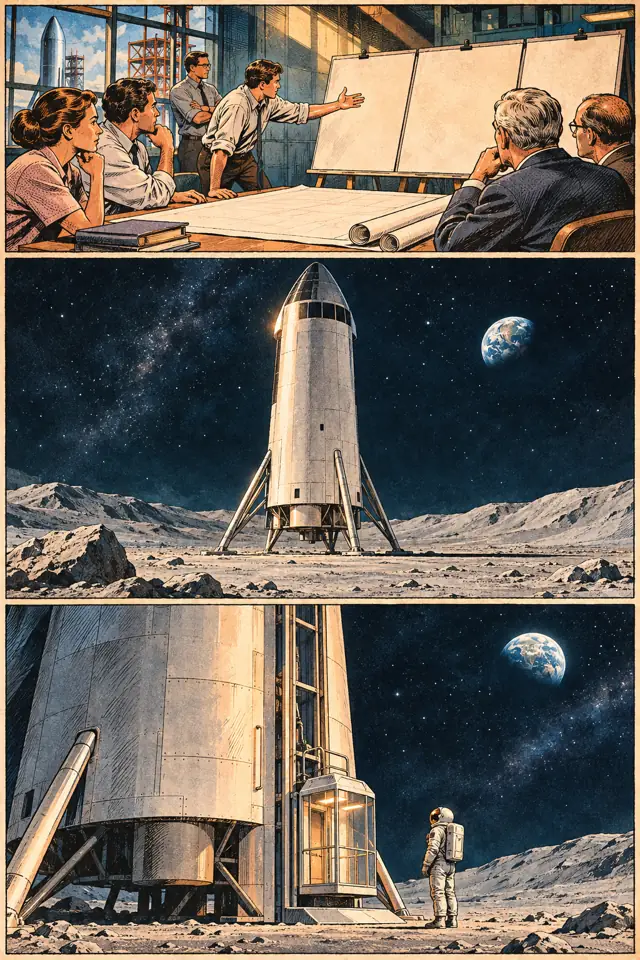
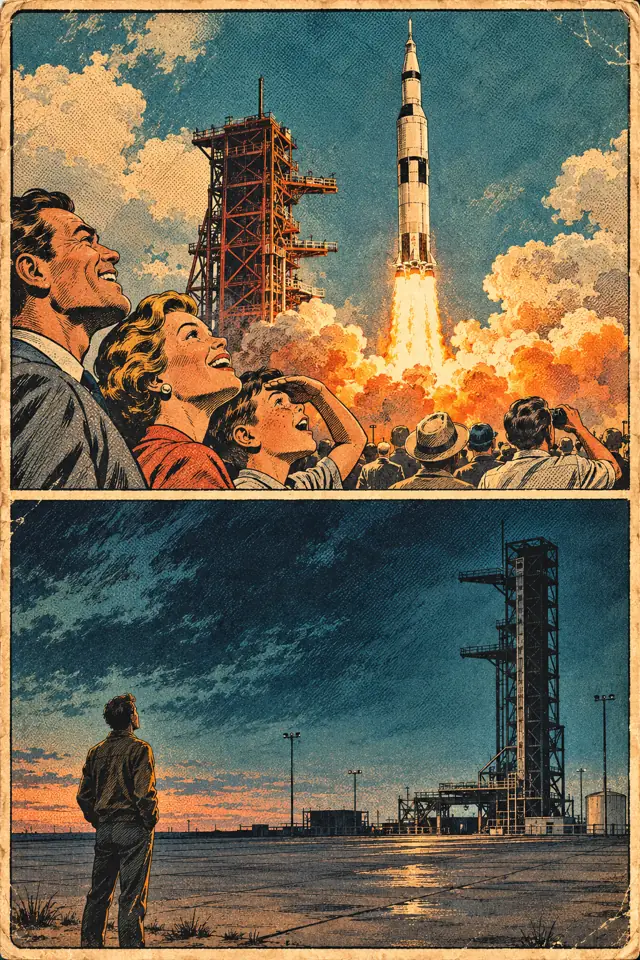
A historically inspired Apollo-era Saturn V rocket lifting into a pale 1960s sky.
1

I · Sparks · 1969–2001

The Age of Giants

Human beings had stood on the Moon. That fact made the future seem limitless. Yet by the beginning of the new century, reaching orbit remained fantastically difficult, expensive, and rare.

Most launch vehicles were enormous one-use machines built inside national programs or established aerospace businesses. A rocket could carry a satellite—and then much of that remarkable hardware would be discarded.

The question beneath this story is not whether rockets can fly. It is whether they can become ordinary enough to change what humanity does next.

Field note: Historical context: Apollo 11 landed in 1969; SpaceX would be founded in 2002.

Page 1 of 63
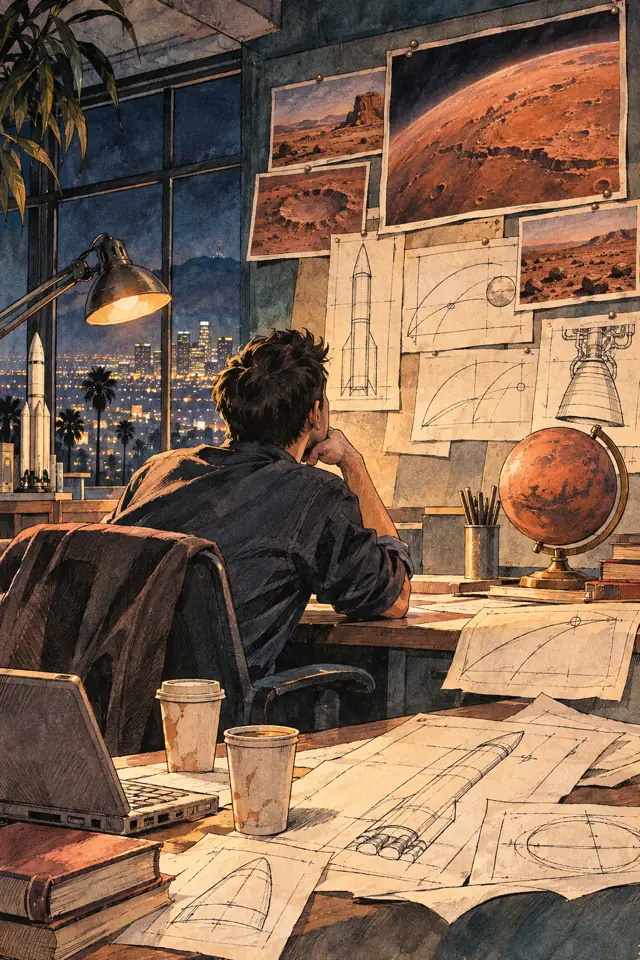
A man sits at a cluttered desk with rocket sketches, a globe and pictures of Mars on the wall.
2

I · Sparks · 2001

The Question

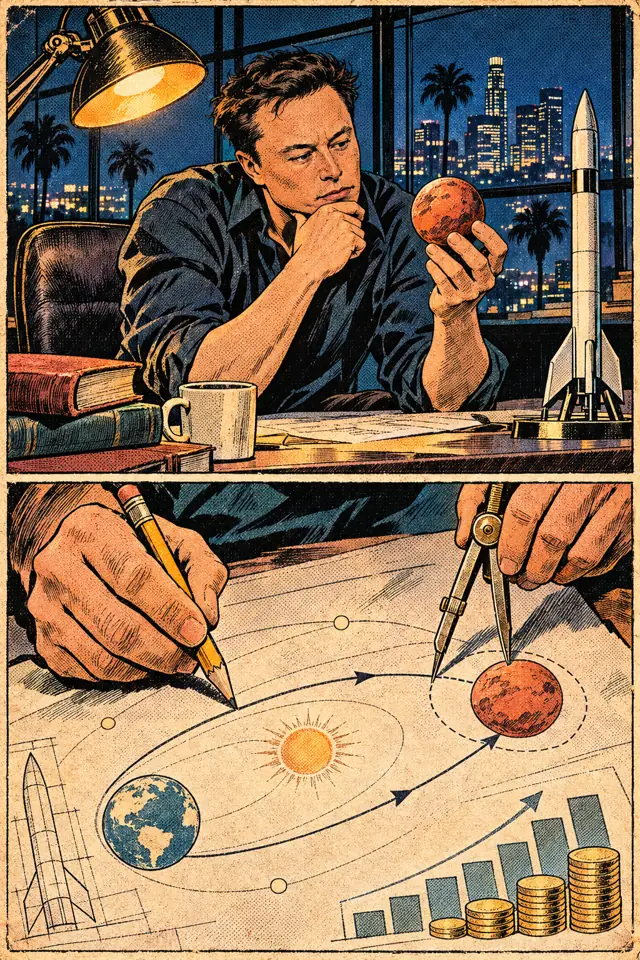
In the early 2000s Elon Musk, already known for internet businesses, became fascinated by an uncomfortable contrast: spectacular space-age achievements and an underdeveloped path to everyday space travel.

Mars was a symbol of the ambition. But the immediate bottleneck was access to orbit. If a launch always required extraordinary expense, almost every grand plan stopped at the launchpad.

He began looking closely at rocket economics. How much of the price came from physical materials? How much came from the way the vehicles were designed, built, tested, and discarded?

This would become the company's defining habit: take an accepted cost or constraint, and ask which part of it is truly unavoidable.

Field note: Vision: reaching Mars was the long-term goal; early company work concentrated on affordable orbital launch.

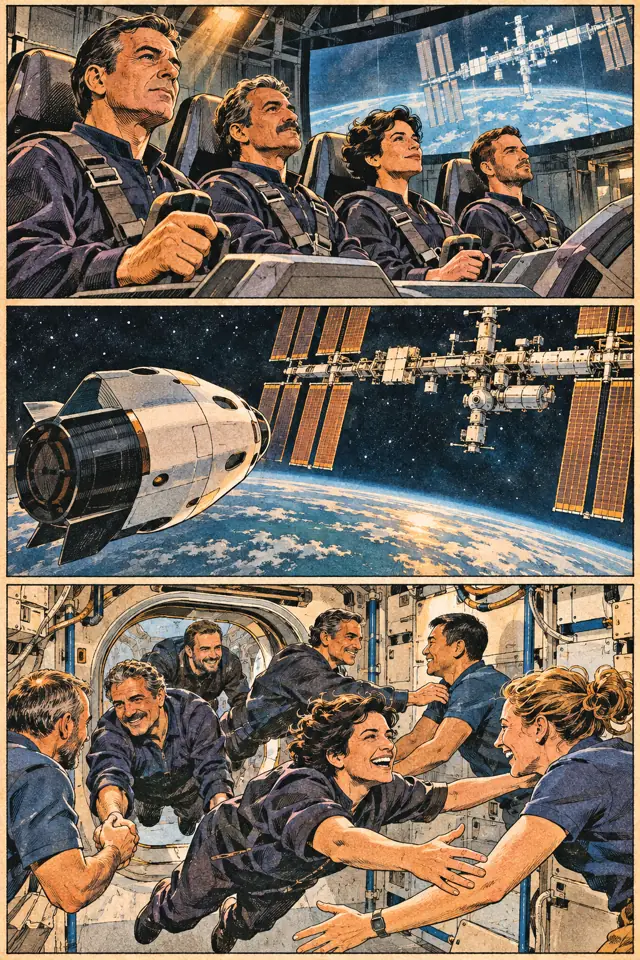
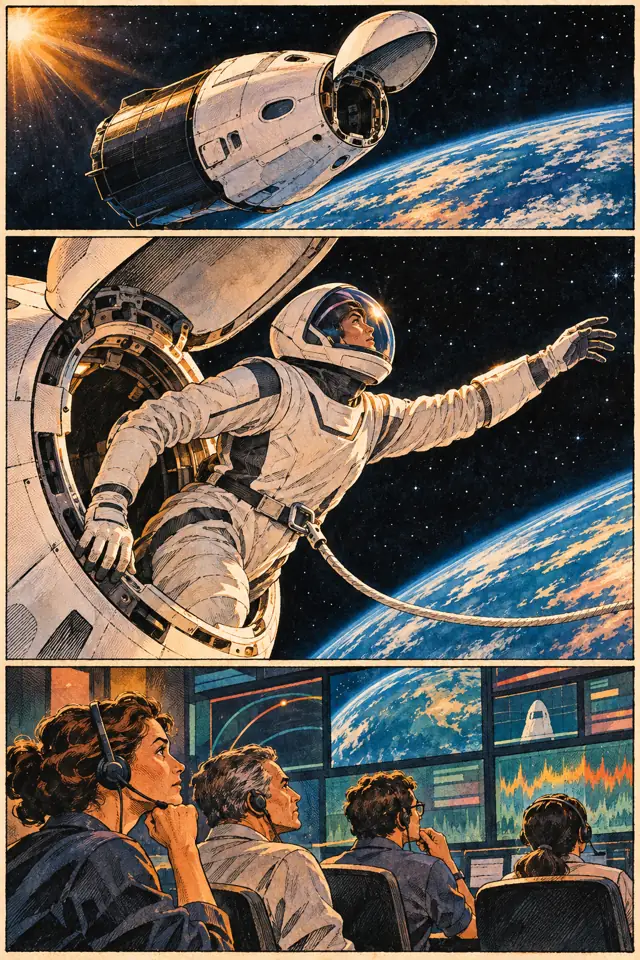
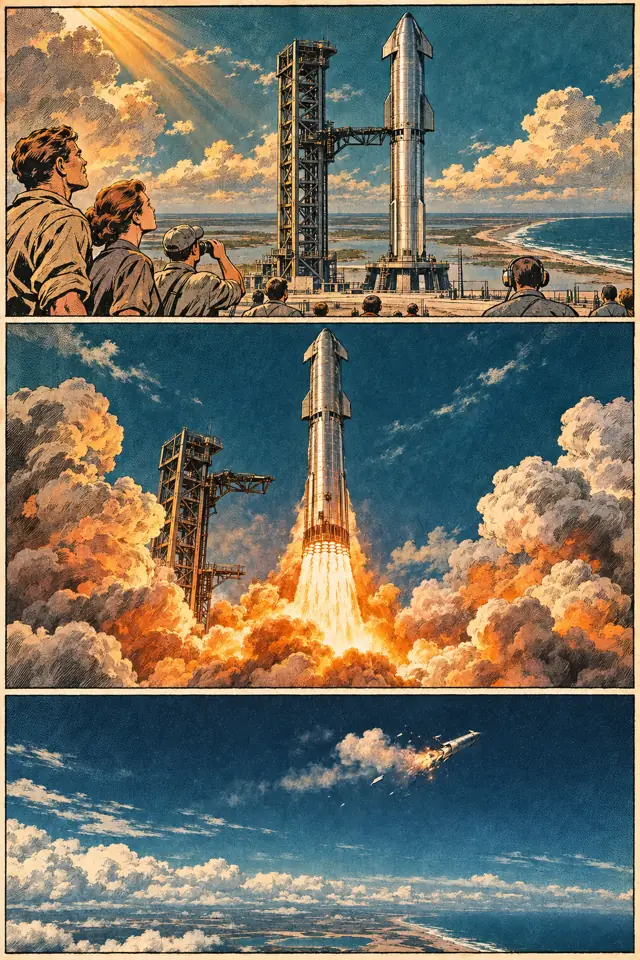
Page 2 of 63
An adult dark-haired technology entrepreneur studies a tiny handmade Mars-globe and a model rocket.
3

I · Sparks · 2001–2002

The Arithmetic of Impossible

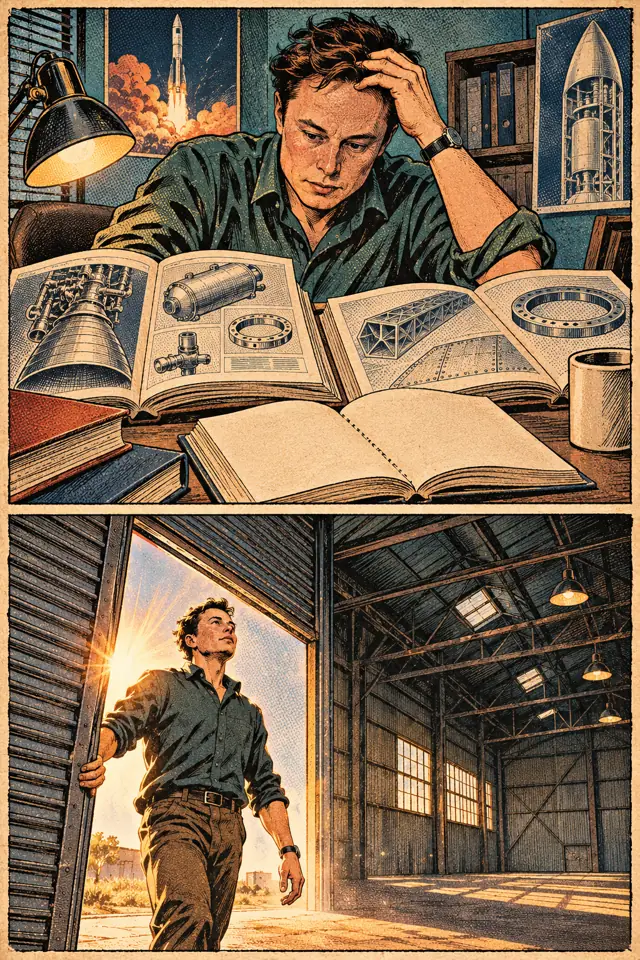
A rocket is not a single object. It is engines, tanks, valves, software, sensors, structures, range safety systems, ground equipment, and hundreds of decisions that must work together.

Buying a finished ride was one option. Building a supplier from scratch was another—and far riskier. Either way, fuel, testing, talent, and failures would all cost real money.

The disruptive idea was not to make physics easier. It was to change the engineering and business process around the physics: develop quickly, own critical technology, and build toward repeatability.

The numbers were daunting. But they were not the same as a proof that it could not be done.

Field note: Engineering note: launch price includes far more than the raw materials in the rocket.

Page 3 of 63
An optimistic but anxious young dark-haired founder looks at aerospace component catalogs with blank pages in modest office.
4

I · Sparks · 2002

Build It Ourselves

Space Exploration Technologies—soon known simply as SpaceX—was founded in 2002. Its ambition was unusually direct: make launch services less expensive and ultimately support travel beyond Earth.

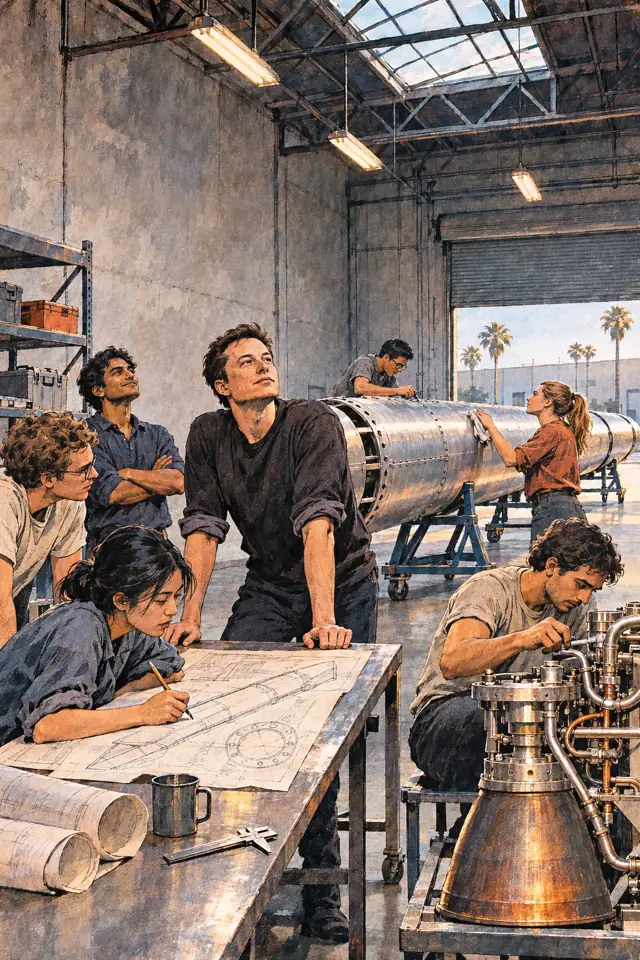
There was no complete rocket waiting on a shelf. Engines would need to be designed. A launch site would need to be secured. Engineers would need a workplace and a culture that let them test ideas quickly.

A startup can move quickly because fewer layers separate a problem from the person able to solve it. But speed brings responsibility: failures in aerospace are unforgiving.

The empty warehouse looked nothing like the future of spaceflight. It was where that future had to begin.

Field note: Founded: 2002, California. Name: Space Exploration Technologies Corp. (SpaceX).

Page 4 of 63
Young engineers gather around a rocket engine and drawings in a bare workshop.
5

I · Sparks · 2002

The Warehouse

Early SpaceX worked in modest industrial space around El Segundo, California. Engineers unpacked tools and built up test equipment while every hour of work consumed a limited budget.

The team aimed to design engines, structures, guidance systems, and manufacturing processes in unusually close collaboration. Problems could move from a desk to a machine shop without crossing organizational continents.

That did not make the work easy. A tiny company had to learn many disciplines that established launch providers had spent decades mastering.

In the beginning, there was no grand launch complex, no fleet of rockets, no station cargo contract. There were people deciding that the difficult thing was worth doing.

Field note: The earliest SpaceX vehicles were the small Falcon 1 and its Merlin and Kestrel engines.

Page 5 of 63
A brilliant middle-aged engineer with slightly wavy dark hair intensely studies Merlin engine nozzle.
6

I · Sparks · 2002–2003

The People Behind the Fire

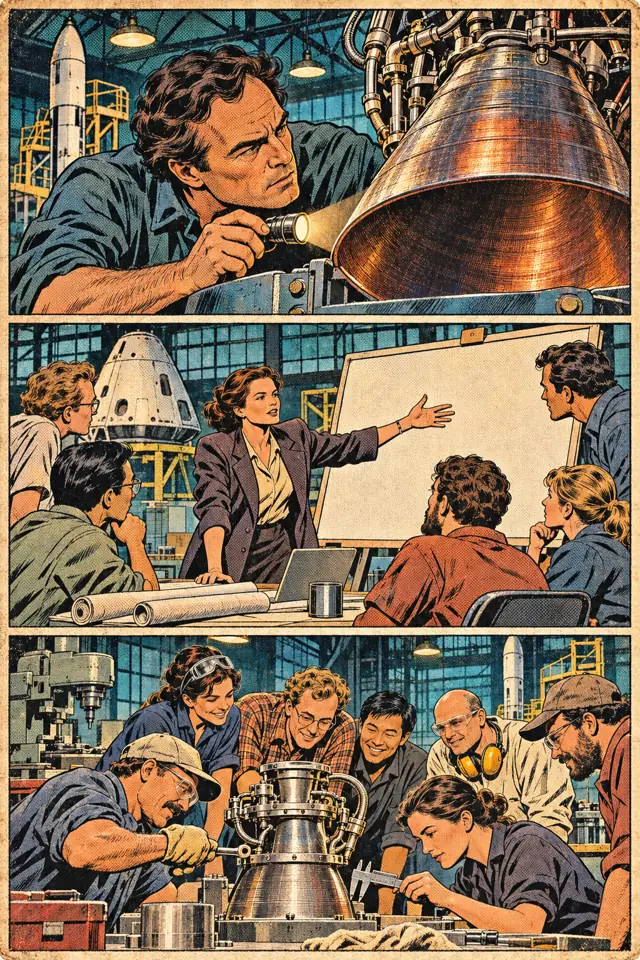
No one person can design, test, sell, and launch a rocket. SpaceX needed propulsion specialists, machinists, software engineers, quality teams, mission planners, and people able to win customers' confidence.

Tom Mueller became a key figure in the early engine program. Gwynne Shotwell helped develop the company's business and customer relationships, later becoming president and chief operating officer.

Every group depended on another. A valve drawing mattered to the test engineer. A launch date mattered to the customer. One neglected interface could defeat an otherwise brilliant design.

A rocket is teamwork made visible through fire.

Field note: People: the company's later milestones depended on employees, suppliers, customers, and NASA partners as well as its founder.

Page 6 of 63
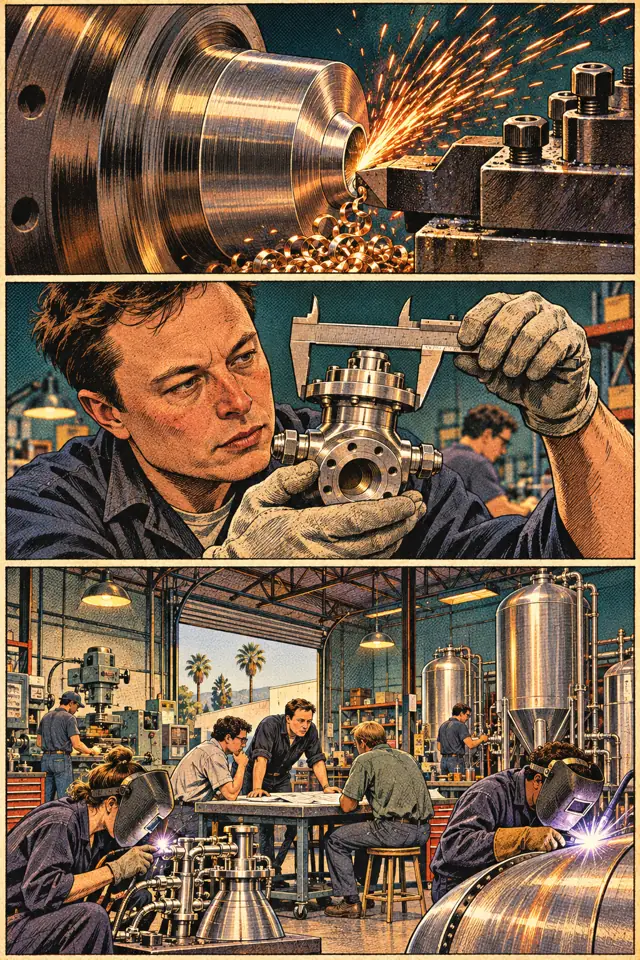
Extreme close lathe shaving bright sparks from silver metal, gloved hands holding machined rocket valve under calipers.
7

I · Sparks · 2003

Every Bolt Counts

The new team pursued extensive in-house design and manufacturing. Parts were cut, welded, inspected, redesigned, and tested within an increasingly integrated operation.

A turbopump must keep liquid propellants flowing at tremendous rates. A valve must open correctly under vibration and cold. Software must interpret the vehicle's state while events unfold in fractions of a second.

The appeal of building so much internally was speed of learning and control over design choices. The cost was that the young company had to master many kinds of risk at once.

A glittering rocket begins as a mountain of unglamorous details.

Field note: Engineering note: rocket reliability emerges from interfaces between subsystems, not just from the engine thrust number.

Page 7 of 63
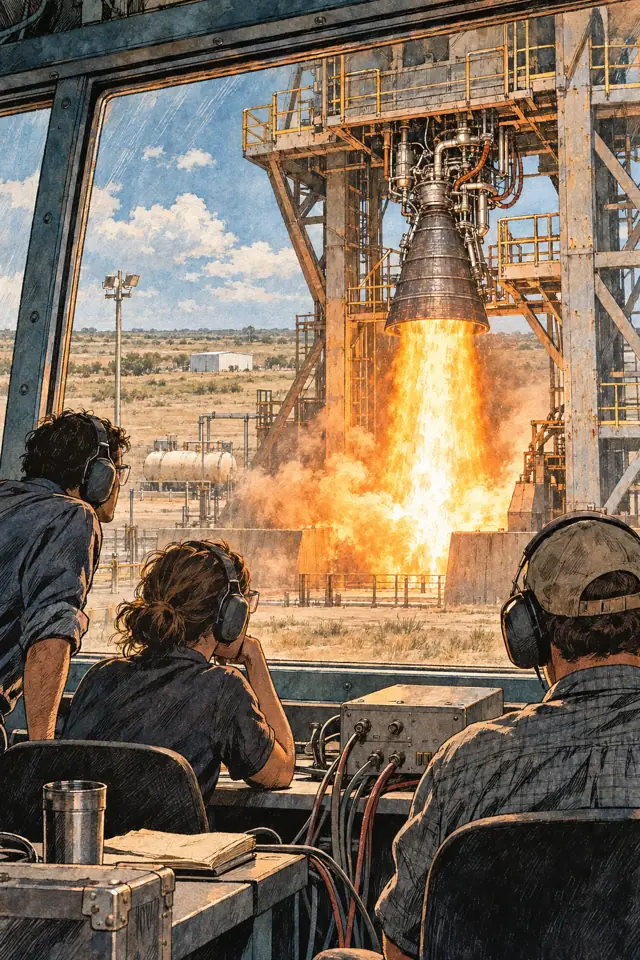
Engineers in a control room watch a rocket engine fire on a test stand.
8

I · Sparks · 2003

Fire, Metal, Mathematics

In McGregor, Texas, engine testing turned drawings into reality. The Merlin family would become the heartbeat of the Falcon vehicles.

A firing stand lets engineers measure pressures, temperatures, combustion stability, and performance while the rocket is still on Earth. A test that exposes a fault can be enormously valuable—even when it looks like failure from a distance.

The team iterated on hardware, manufacturing, and procedures. Each engine test made the next decision more informed.

This is the paradox of rocket development: before a machine can become trustworthy, engineers must deliberately give it many chances to reveal why it is not.

Field note: By early 2003 SpaceX was testing early Merlin and Kestrel engine prototypes in Texas.

Page 8 of 63
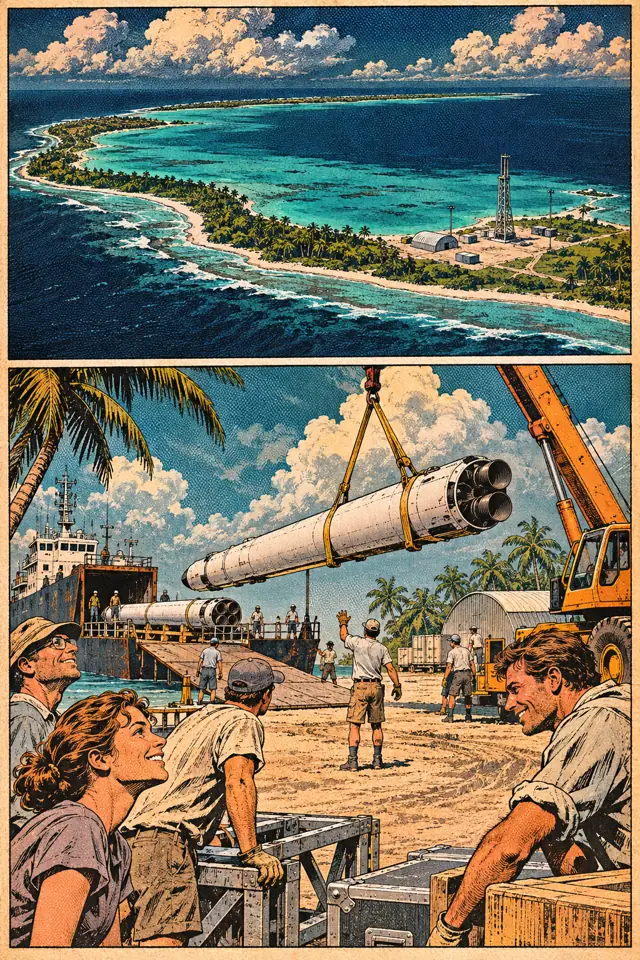
Aerial view isolated turquoise tropical atoll with tiny launch infrastructure near shoreline.
9

I · Sparks · 2004–2005

An Island at the Edge of the Map

Launching a new rocket required more than a workshop. It required range permissions, a remote pad, tracking, communications, weather planning, fuel handling, and an immense amount of transport.

The Falcon 1 campaign moved toward Omelek Island at Kwajalein Atoll in the Pacific. The geography offered an open launch corridor, but isolation complicated almost every ordinary task.

Rocket components had to survive shipping and be assembled under tropical conditions. When a tool was missing, the nearest replacement was not down the street.

The ocean looked peaceful. Inside the team, the pressure was building.

Field note: Launch geography: Falcon 1 would fly from Omelek Island at Kwajalein Atoll, Marshall Islands.

Page 9 of 63
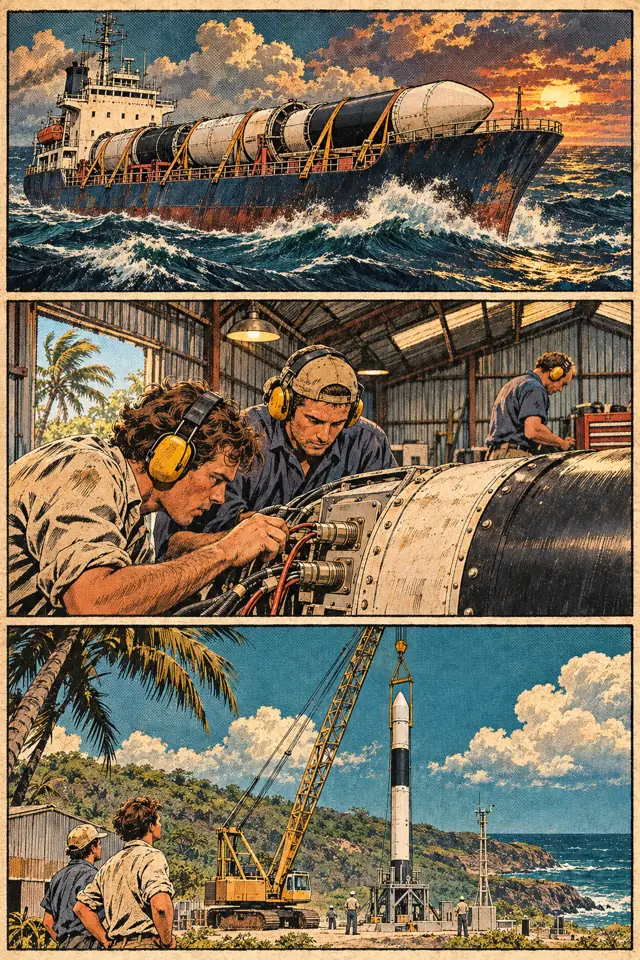
Tall rocket sections lashed on cargo ship deck crossing rough Pacific, mechanics wearing hearing protection checking electrical connectors in corrugated-shed workshop.
10

II · Three Fallen Falcons · 2005

Cargo for the Edge of the World

Rocket development now involved ships, cranes, containers, and logistics plans. Falcon 1 hardware traveled across the Pacific to the island launch site.

Every item had to arrive in usable condition: engine systems, structures, avionics, support gear, and the parts that made the pad itself function. Humidity, salt, and scheduling would not make exceptions for ambition.

A delay might have little to do with rocket science. It might be a missing connector or an instrument that needed a replacement thousands of miles away.

Before they could launch a rocket, they had to build the machinery of launching rockets.

Field note: Logistics lesson: a launch campaign includes range coordination, propellants, safety, tracking, and transport.

Page 10 of 63
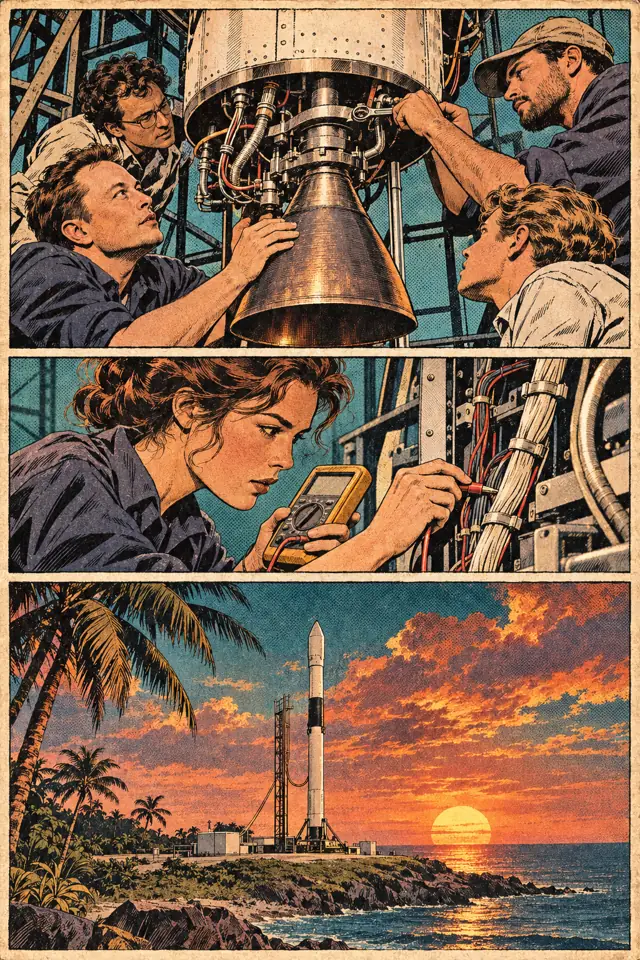
Engineers in close proximity carefully securing a Merlin engine under small slender rocket, a woman technician traces a wiring harness with multimeter.
11

II · Three Fallen Falcons · 2005–2006

The First Falcon

Falcon 1 was deliberately smaller than the orbital rockets of major national programs. A single Merlin engine powered its first stage; a Kestrel engine would operate the second.

The narrow vehicle promised a cheaper path for small satellites, but small did not mean simple. The second stage still had to reach orbital speed, and the guidance system had to place its payload on the planned trajectory.

Technicians integrated the rocket and checked fuel lines, electronics, separation systems, and launch procedures. Each checklist existed because a tiny overlooked detail could become a major event.

The first attempt was no longer theoretical.

Field note: Falcon 1: two stages, one Merlin-powered first stage, one Kestrel-powered upper stage.

Page 11 of 63
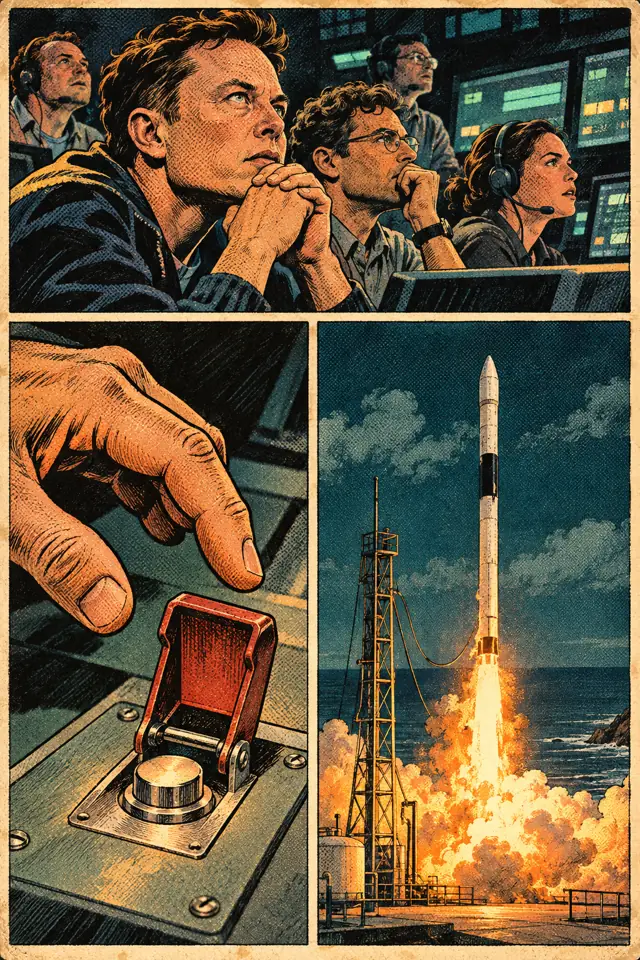
Intense remote mission-control faces lit by abstract instrument glow, close-up technician hand hovering over plain unlettered launch switch.
12

II · Three Fallen Falcons · MARCH 2006

Ignition

On the remote island, the launch team prepared for its first orbital attempt. The rocket stood exposed above the ocean while engineers watched telemetry screens from protected control positions.

A countdown compresses years of design work into seconds. Valves move; engines ignite; pressure, temperature, and thrust must stay inside a narrow corridor.

Falcon 1 lifted away. For a moment it was everything the team had tried to build: a machine leaving its own pad under controlled rocket power.

The most difficult part of the experiment had only begun.

Field note: Date: March 24, 2006 (local March 25); Falcon 1 Flight 1 launched from Omelek Island.

Page 12 of 63
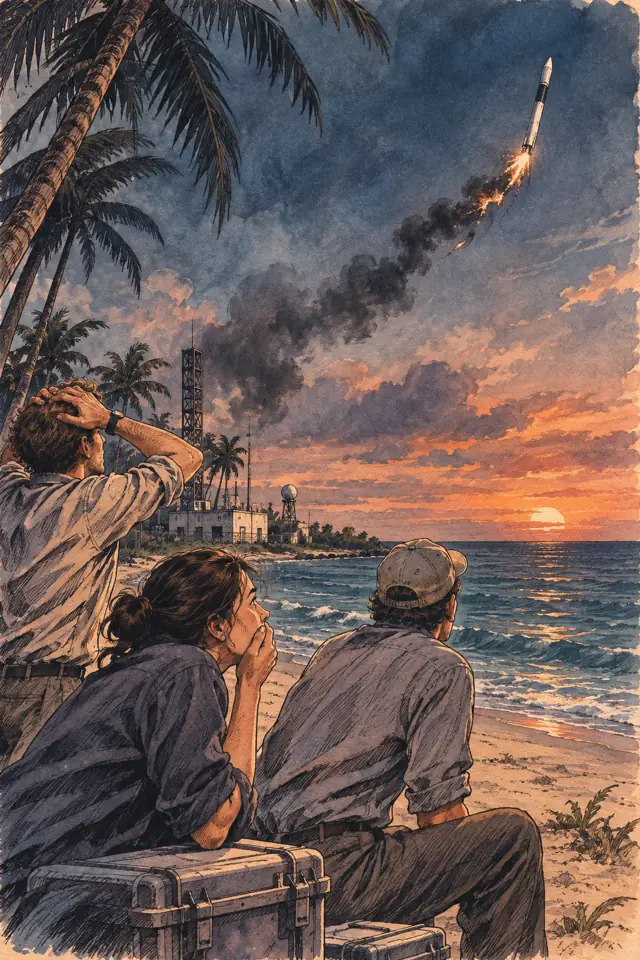
People on a tropical beach watch a rocket trail break apart in the sunset sky.
13

II · Three Fallen Falcons · MARCH 2006

Thirty-Three Seconds

The first Falcon 1 flight ended soon after liftoff. An engine-area fire caused loss of thrust, and the vehicle did not reach orbit.

The images were brutal, but the most important evidence lived in measurements and the physical remnants. The problem was not simply that a rocket failed; the problem was discovering the actual chain of events.

An accident investigation has to distinguish the first initiating fault from the many secondary effects that follow it.

The team would have to work through disappointment while preparing hardware for another attempt. There was no shortcut around the data.

Field note: Result: Flight 1 failed roughly 33 seconds after liftoff. No orbit was achieved.

Page 13 of 63
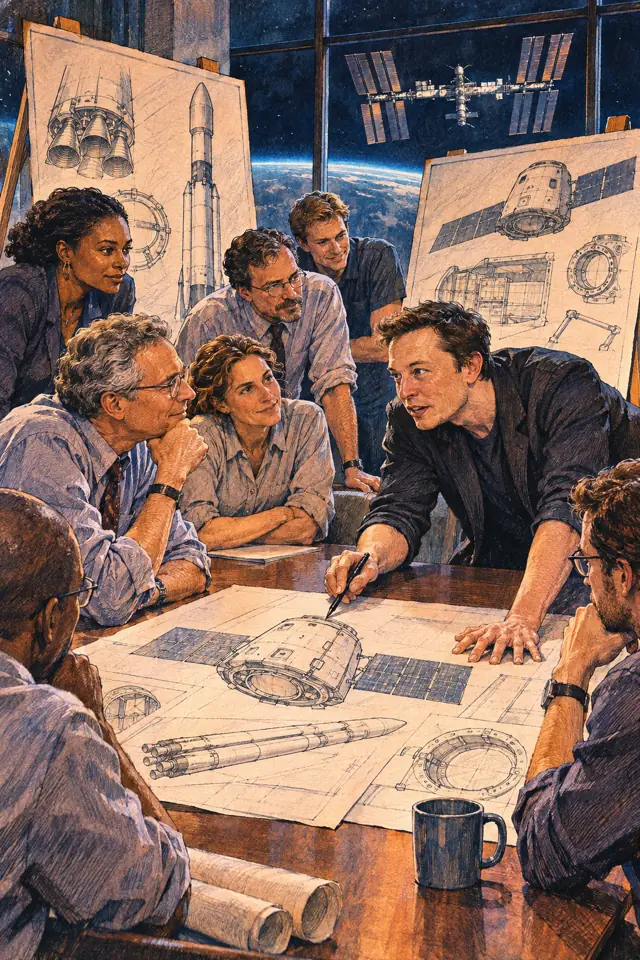
A small team leans over rocket drawings on a table around their leader.
14

II · Three Fallen Falcons · AUGUST 2006

NASA Opens a Door

NASA faced a future without the Space Shuttle. Supplying the International Space Station would still be essential, and the agency wanted private industry to develop new transportation capabilities.

In August 2006 NASA selected SpaceX as an early partner in Commercial Orbital Transportation Services, or COTS, with payments tied to specified development milestones.

That was not the same as NASA buying a finished spacecraft. It was a partnership that combined private investment and engineering with agency insight and technical requirements.

For SpaceX, the opportunity was enormous. The responsibility was equally enormous: eventually, its vehicles had to approach a crewed orbital laboratory safely.

Field note: NASA COTS: a milestone-based development agreement of up to $278 million, not the later resupply-service contract.

Page 14 of 63
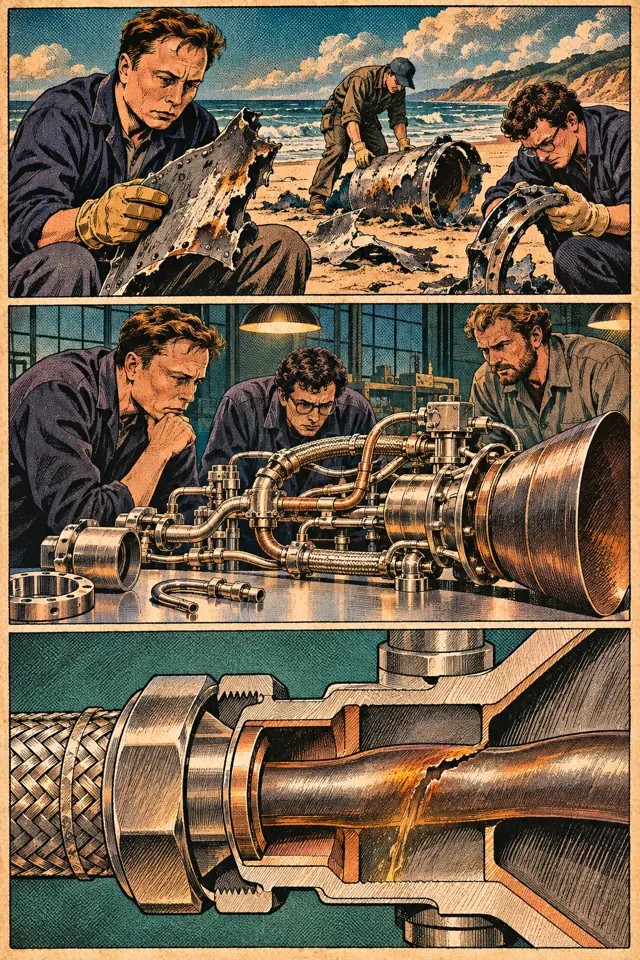
Engineers recover charred twisted metal rocket components from sandy Pacific shore with safety gloves, high-angle engine plumbing assembly laid out on clean lab bench.
15

II · Three Fallen Falcons · 2006–2007

Failure Analysis

Engineers compared sensor data with hardware evidence to trace the first flight's early engine failure. Repairing the visible damage would be pointless unless the design and process problem was understood.

A fuel system is a chain of tanks, pipes, fittings, valves, and seals. Under launch vibration and heat, weaknesses that seem minor on the ground can become decisive.

The company revised equipment and procedures and prepared a second flight. This was a stressful lesson in systems engineering: no subsystem can be treated as isolated from the rest.

What looked from outside like a second try was, to the engineers, a large collection of corrections.

Field note: Engineering lesson: root-cause investigations seek initiating faults and corrective actions, not just the most visible symptom.

Page 15 of 63
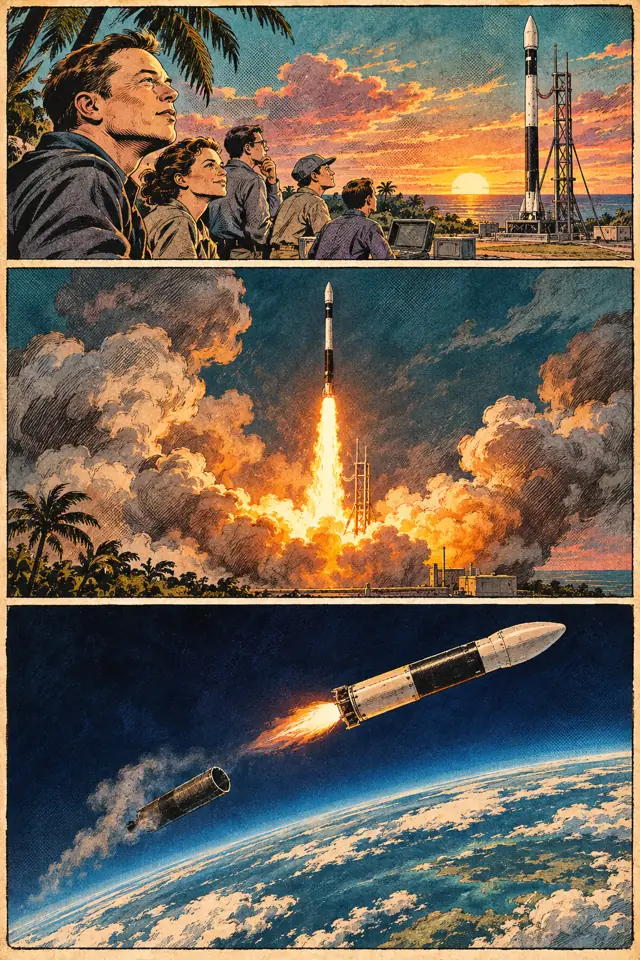
Tropical sunrise on a solitary slender rocket and tiny human crew, golden launch flame pierces smoky clouds.
16

II · Three Fallen Falcons · MARCH 2007

The Second Attempt

On Falcon 1's second flight, the launch vehicle climbed much farther than before. Its first stage functioned long enough to carry it through the early mission.

There was relief, but no one could celebrate yet. A two-stage launcher succeeds only if separation, upper-stage ignition, control, and final orbital insertion all work.

For a team that had watched the first rocket disappear, the longer flight represented hard-earned progress. To customers, however, the central requirement was unchanged.

Either the payload reached its intended orbit—or it did not.

Field note: Falcon 1 Flight 2: March 2007. Improved flight performance, but it still failed to reach orbit.

Page 16 of 63
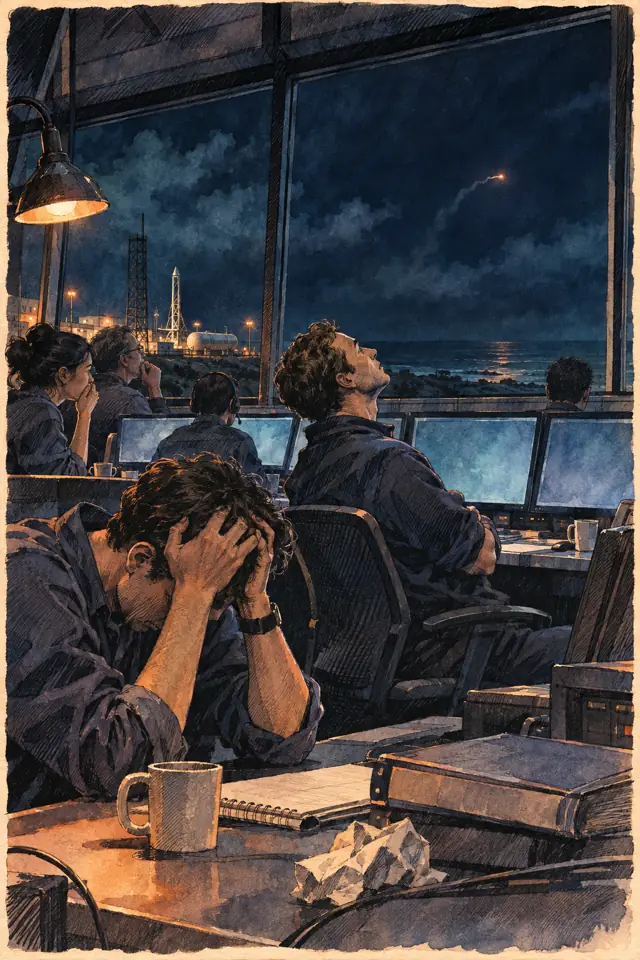
An engineer holds his head in his hands in a dark control room after a failed launch.
17

II · Three Fallen Falcons · 2007

Not Yet

The second mission ended short of orbit. This time SpaceX was not facing the same early fire; the later flight encountered control and stability trouble.

Different failure modes mattered. They meant the team had made progress on some problems while exposing others that could only be seen in a longer, higher-energy flight.

The loss was real, but so was the information. Engineers returned to simulations, tests, and design meetings with a larger view of how the rocket behaved.

A failed mission does not prove nothing was learned. It proves that learning has not yet become reliable operation.

Field note: Result: Flight 2 did not complete orbital insertion, despite surviving the earliest portion of ascent.

Page 17 of 63
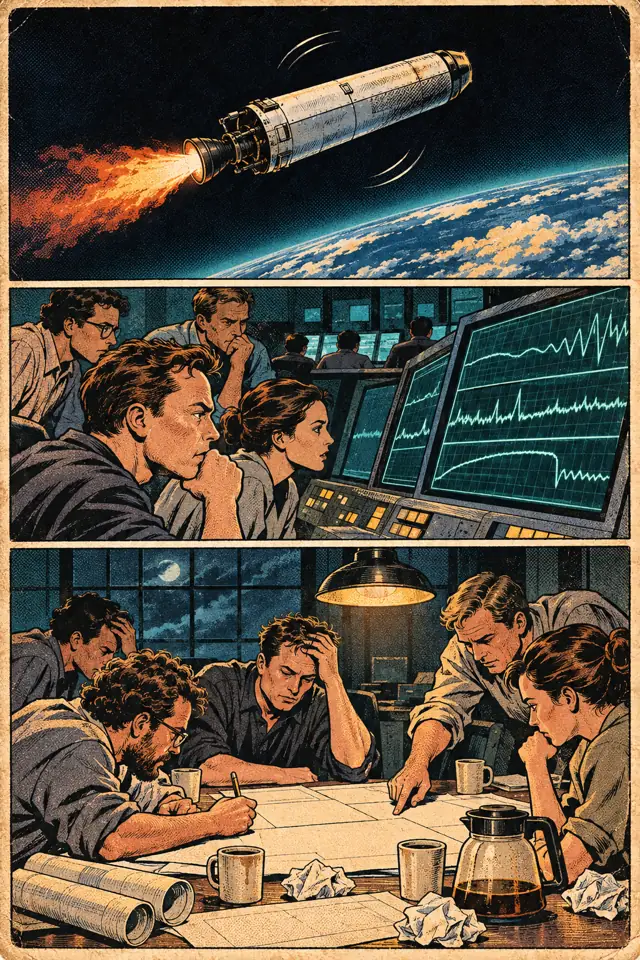
Upper-stage rocket silhouette against black high-altitude sky tumbling slightly, mission control engineers studying unlabeled waveform-like telemetry traces.
18

II · Three Fallen Falcons · 2007–2008

The Data Doesn't Lie

Guidance systems continuously correct how a flying rocket points and rotates. Even small oscillations can grow when vehicle dynamics, changing mass, and control inputs interact.

The Falcon 1 team examined the second flight's late-stage behavior, then revised hardware, models, and control strategies. Failure analysis meant hours of unglamorous argument over what the measurements actually showed.

Space projects reward both audacity and humility. A confident prediction is useful only until new evidence contradicts it.

By the time the next rocket was ready, the pressure on the young company was far greater than it had been on the first launch.

Field note: Engineering note: attitude control keeps a rocket pointed correctly as it burns fuel and separates stages.

Page 18 of 63
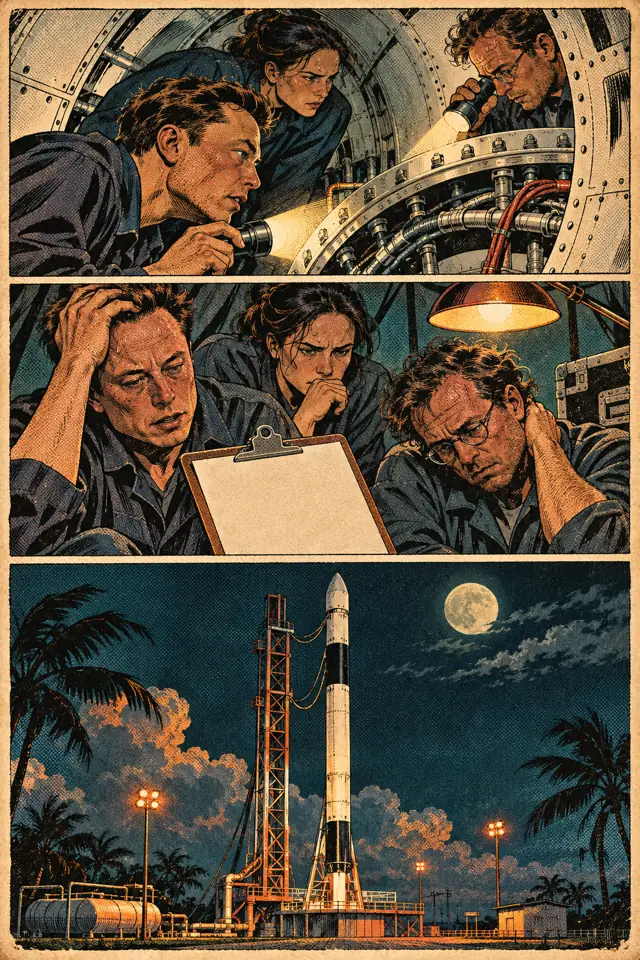
Technicians intensely checking rocket interface ring with flashlights in cramped white fuselage.
19

II · Three Fallen Falcons · AUGUST 2008

Flight Three

The third Falcon 1 had years of learning built into its materials and code. Crews checked the interfaces, rehearsed the countdown, and trusted measurements that had been earned the hard way.

An orbital rocket is also a financial commitment. Each failure consumed expensive hardware, labor, and time, while the small company still had to pay for the next vehicle.

The rocket lifted off. First-stage flight looked stronger than before. The decisive moment now lay at staging, when one vehicle must become two without disturbing the upper stage.

That moment had not yet been mastered.

Field note: Flight 3: August 2008, the third Falcon 1 orbital launch attempt.

Page 19 of 63
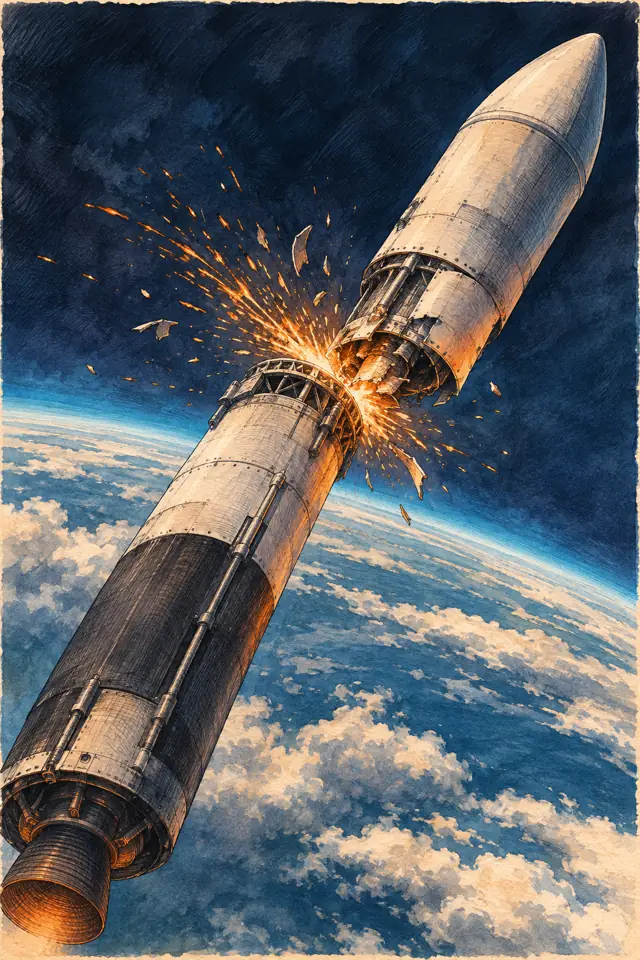
A rocket stage separates high above the Earth, with sparks at the joint.
20

II · Three Fallen Falcons · AUGUST 2008

The Third Fall

During third-flight stage separation, the first and second stages collided, ending the mission. The failure arrived exactly where the hardware had to perform a precise choreography.

The first stage was supposed to move safely away. Its residual thrust and timing complicated that separation enough to interrupt the sequence.

The screen returned a verdict of failure, but engineers saw a different technical problem from either of the previous launches.

Three flights had ended without orbit. The next flight would carry not just a payload simulator, but the credibility of the entire effort.

Field note: Root problem: stage separation failure caused by contact between the first and second stages.

Page 20 of 63
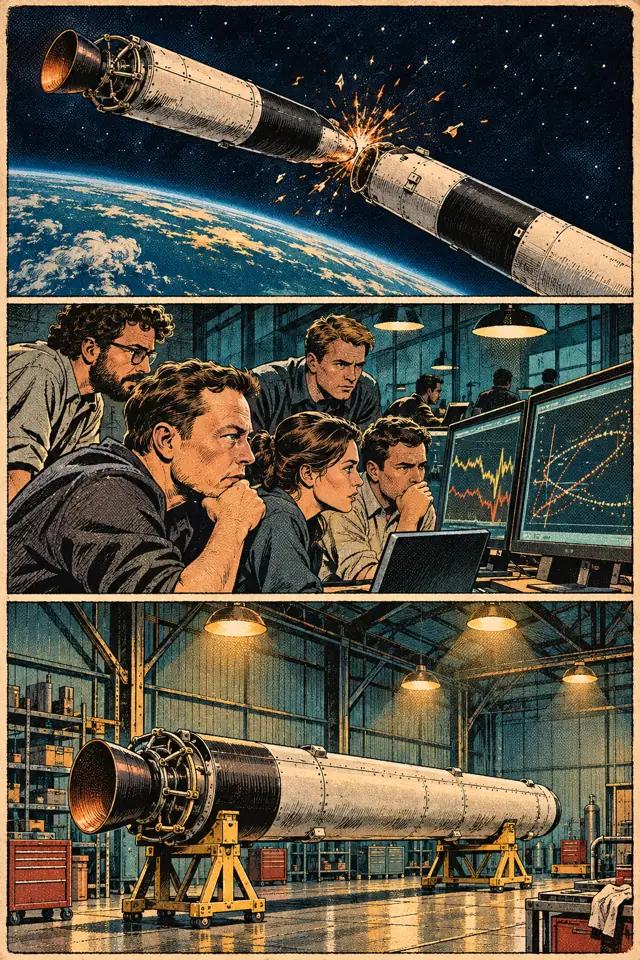
Two separated slender rocket stages touch in space near Earth's curve producing sparks, engineers at computers staring at abstract unfocused plots.
21

II · Three Fallen Falcons · 2008

One More Rocket

The team investigated staging behavior, modified the next vehicle, and continued preparing an additional Falcon 1 that could fly sooner than an entirely new production campaign.

This period became part of SpaceX's survival story. The company was investing heavily while customers still could not point to an orbital success.

The fourth flight was neither guaranteed to work nor guaranteed to save the company if it failed. That uncertainty was real, and the people fixing the vehicle had to keep working inside it.

What changed was not belief alone. It was the configuration of the next rocket and the evidence supporting it.

Field note: Risk: three failed attempts left the company under serious technical and financial pressure.

Page 21 of 63
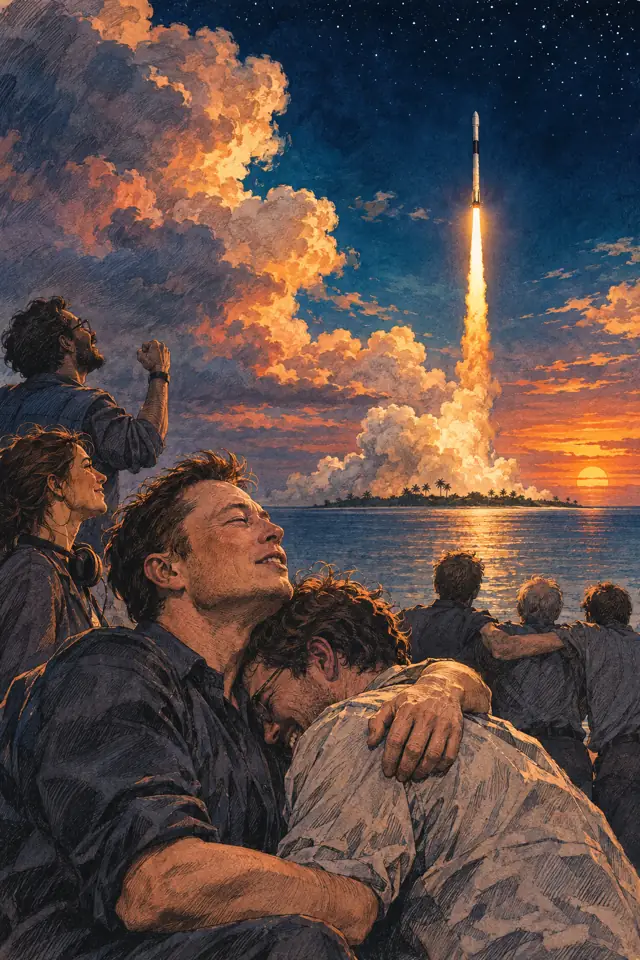
Team members embrace on a shore as a rocket climbs into an orange sky.
22

II · Three Fallen Falcons · SEPTEMBER 2008

Orbit

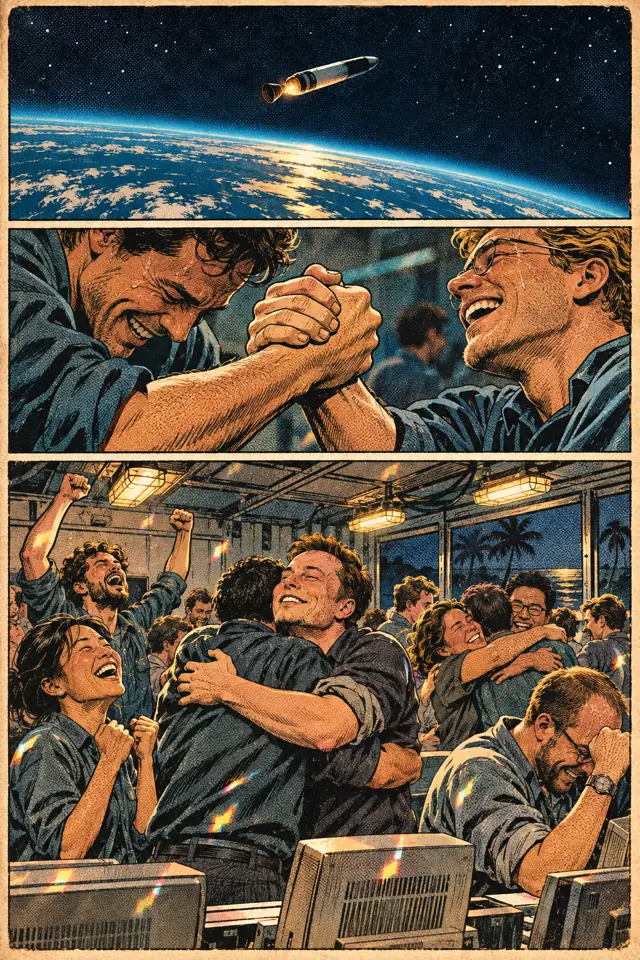
On September 28, 2008, the fourth Falcon 1 reached Earth orbit. A privately developed liquid-fueled rocket had achieved something that had previously eluded comparable private efforts.

Every critical step had to work: launch, staging, upper-stage burn, and orbital insertion. For the first time the telemetry told a complete success story.

Engineers and managers who had endured years of failed attempts could finally celebrate an objective result—not a promise, not a simulation, not a press release.

Falcon 1 had proved a private rocket startup could build a vehicle capable of orbit. Its larger ambitions were still unproven.

Field note: First: privately developed liquid-fueled rocket to reach orbit, Falcon 1 Flight 4, September 28, 2008.

Page 22 of 63
Tiny upper-stage rocket silhouette above blue glowing Earth curve, close-up gloved mission engineer hands clasping another engineer's hand.
23

II · Three Fallen Falcons · SEPTEMBER 2008

A Different Sky

From the ground, the rocket looked like a line of flame. From mission control, it became a sequence of numbers resolving into the one word the engineers needed: orbit.

The successful flight did not erase any of the failures. It depended on them; each had revealed a limitation the next design had to confront.

SpaceX now had proof that could be shown to customers, investors, and partners. Proof changes a conversation in a way that ambition alone cannot.

But the real test of a launch business is not doing something once. It is doing it again, safely, on a schedule, with a customer's spacecraft aboard.

Field note: What changed: orbital success established technical credibility; dependable service still had to be demonstrated.

Page 23 of 63
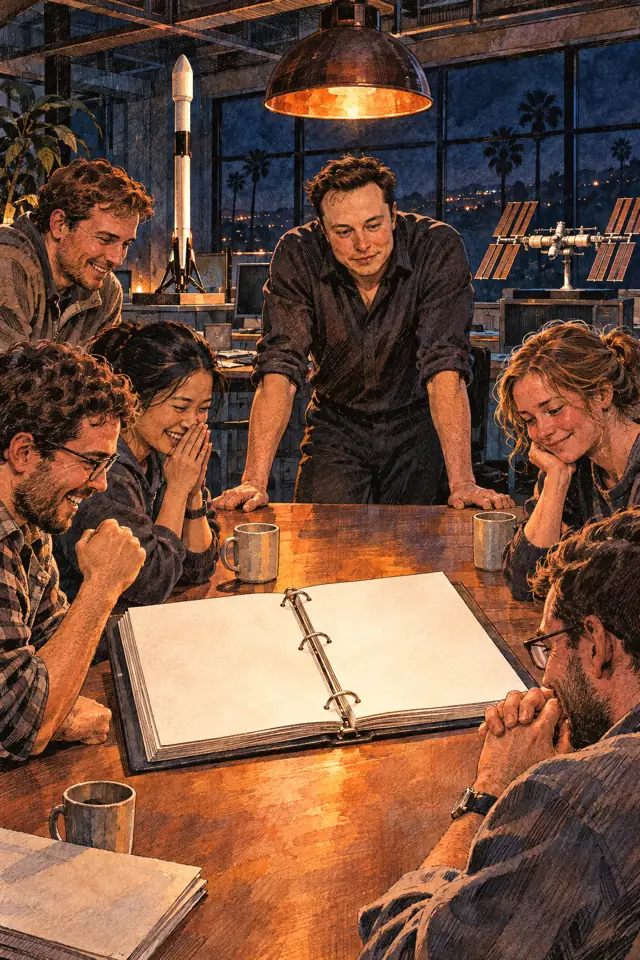
A team sits around a table with an open binder, listening to their leader.
24

III · Proving It · DECEMBER 2008

A Mission Worth Building

Near the end of 2008, NASA awarded SpaceX a commercial cargo resupply contract valued at roughly $1.6 billion for twelve future space station missions.

The contract was not the same as a lump of cash arriving overnight. Payments and services would depend on completing work and flying missions. The opportunity mattered because it created a long-term customer for a new transportation system.

SpaceX had already won a separate NASA development agreement under COTS in 2006. Now a transition toward buying actual cargo flights was taking shape.

The tiny rocket company had a larger task: build Falcon 9 and Dragon, then make them work together.

Field note: CRS contract: twelve NASA space station cargo flights, approximately $1.6 billion, awarded December 2008.

Page 24 of 63
July 2009 fifth Falcon 1 mission carrying first commercial satellite.
25

III · Proving It · JULY 2009

A Real Customer in Orbit

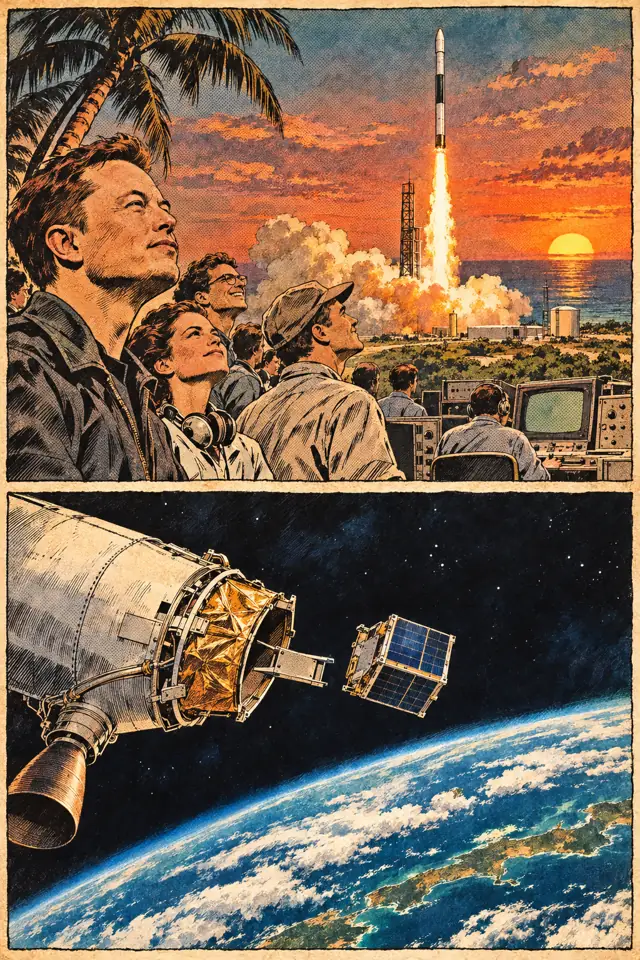
Falcon 1's fifth and final flight carried RazakSAT, a Malaysian Earth-observation satellite, into orbit. Unlike the fourth flight's test payload, this was a genuine commercial mission.

A launch business lives at the intersection of engineering and trust. The payload can represent years of someone else's work and enormous financial responsibility.

The mission showed that the team could put a customer's spacecraft into space. But Falcon 1 alone could not support the much heavier cargo transport SpaceX and NASA were pursuing.

One rocket had opened the door. The next one needed to carry a whole new kind of promise.

Field note: July 14, 2009: Falcon 1 placed the RazakSAT commercial satellite into orbit.

Page 25 of 63
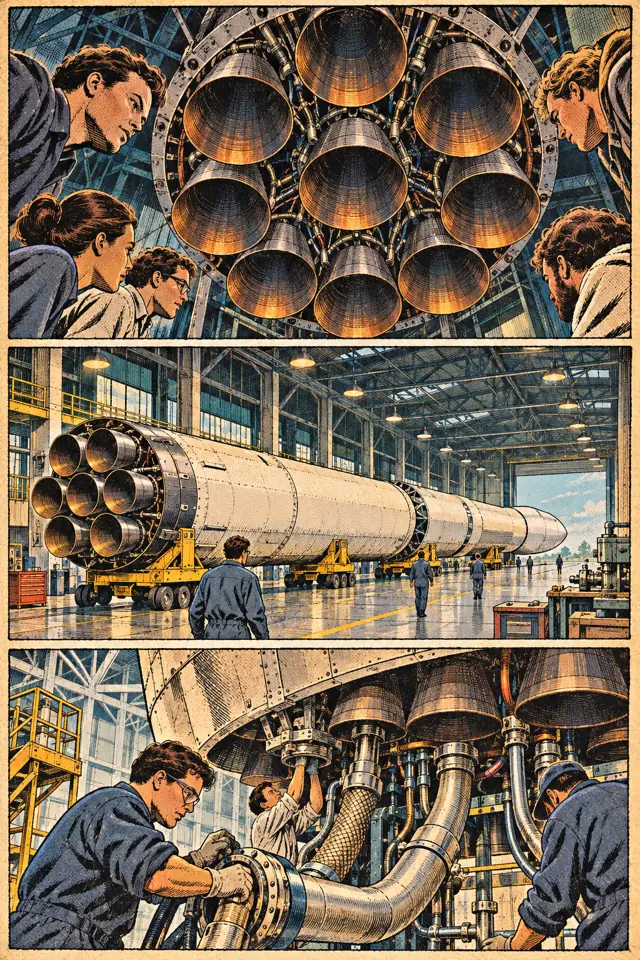
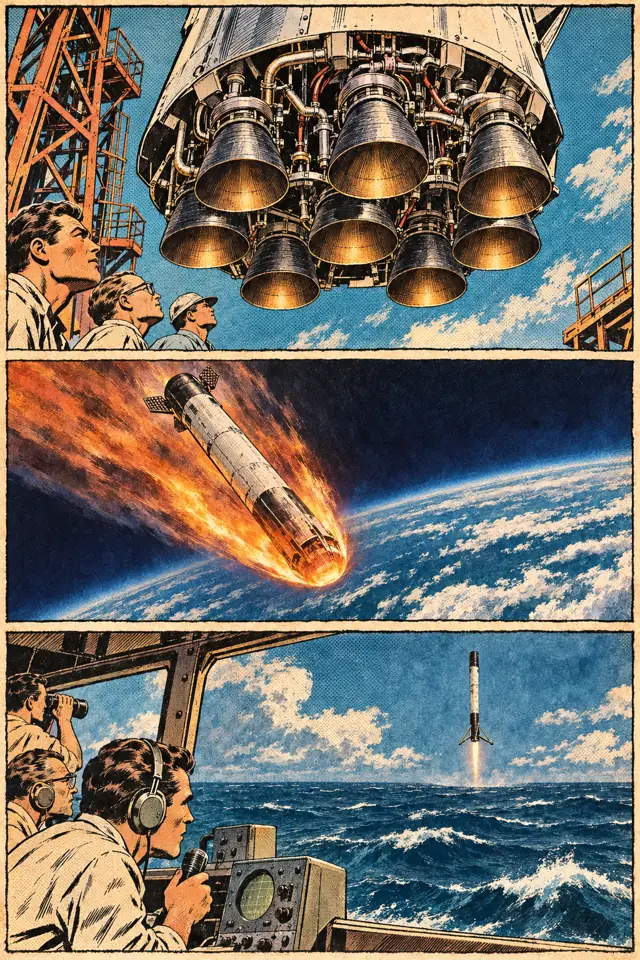
Engineers looking down at nine rocket engine bells arranged in a beautiful circular cluster.
26

III · Proving It · 2009–2010

Nine Engines

Falcon 9 was a major leap in size and capability. Its first stage grouped nine Merlin engines rather than the single engine of Falcon 1.

More engines brought more thrust, plumbing, power systems, and control challenges. Engineers had to coordinate ignition and stage operation across a much larger vehicle.

The rocket was designed to carry Dragon, spacecraft, and other payloads to orbit. It became the basis of a new launch business with broader customers and higher mission requirements.

A small team's engineering methods now had to scale up without losing the feedback loops that made them effective.

Field note: Engineering note: Falcon 9's name refers to the nine Merlin engines on its first stage.

Page 26 of 63
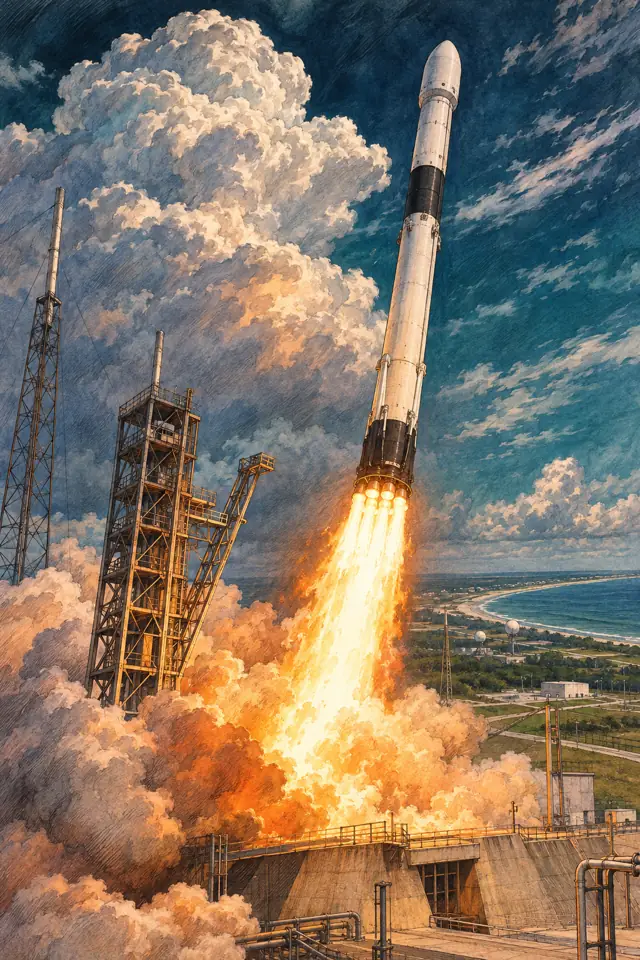
A white Falcon rocket lifts off from a coastal launch pad in clouds of exhaust.
27

III · Proving It · JUNE 2010

The Bigger Falcon Flies

On June 4, 2010, Falcon 9 launched for the first time and achieved orbit. The new rocket was not simply a larger Falcon 1; it had to prove that an ambitious new configuration could fly as intended.

The first stage pushed the vehicle high above Florida, then the upper stage continued accelerating toward orbital speed. Again, success came from a sequence of separate events all going right.

The mission established an essential foundation for Dragon and later customers.

To become a transportation provider, however, SpaceX still needed the other half of the system: a spacecraft that could reach orbit, function, and return.

Field note: Milestone: first Falcon 9 flight, June 4, 2010, reached Earth orbit.

Page 27 of 63
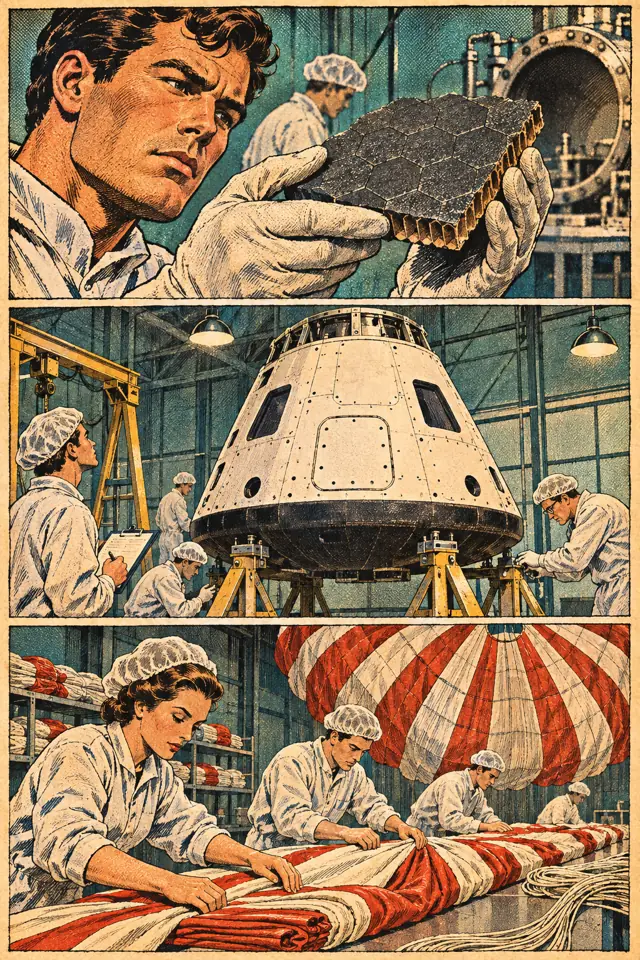
Close heatshield honeycomb sample in gloved hands, black-and-white cone-shaped Dragon capsule on clean-room support stands with technicians in white suits.
28

III · Proving It · 2010

Building the Dragon

Dragon was more than a payload container. It required navigation, communications, power, thermal protection, life-support-related design pathways, parachutes, and recovery operations.

Returning a capsule is a different problem from launching it. The heat shield must survive atmospheric reentry, when kinetic energy becomes tremendous heat. Parachutes then slow the vehicle for splashdown.

For a future station visitor, Dragon also needed precise maneuvers and safe operations near astronauts living hundreds of kilometers above Earth.

The team tested every available part of that sequence on the ground before giving the capsule its first orbital trial.

Field note: Technology: Dragon used a heat shield and parachutes to make recoverable orbital transport possible.

Page 28 of 63
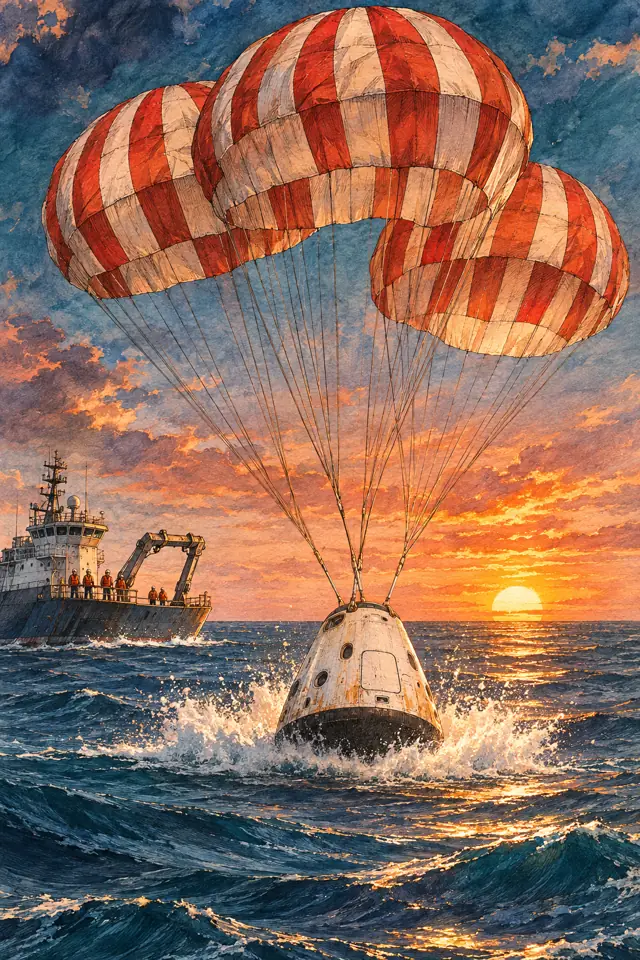
A capsule descends under red-and-white parachutes toward the sea, with a ship nearby.
29

III · Proving It · DECEMBER 2010

Dragon Comes Home

In December 2010 Dragon launched atop Falcon 9, completed its orbital demonstration, reentered Earth's atmosphere, and splashed down in the ocean.

The result was remarkable: a privately developed spacecraft had gone to orbit and been recovered after its mission.

For the team, the recovery was not a theatrical bonus. It was proof that the heat shield, guidance, parachutes, and ocean operations could work as a system.

A spacecraft that comes home can return experiments and supplies from orbit. That was precisely the capability NASA wanted as it reimagined station logistics.

Field note: Milestone: Dragon's first orbital flight and successful recovery, December 8, 2010.

Page 29 of 63
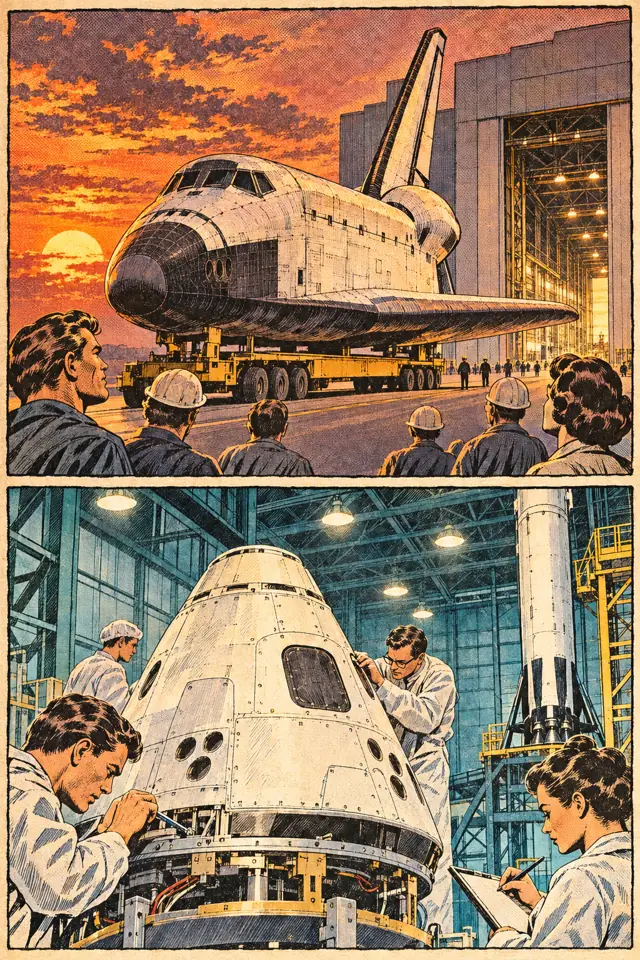
2011 ending of US Space Shuttle program and the transition to commercial cargo.
30

III · Proving It · 2011

After the Shuttle

NASA's Space Shuttle program ended in 2011. The International Space Station did not stop needing food, equipment, research materials, and transport for its crew.

Other international and commercial vehicles continued to support the station. Dragon was being developed as an additional U.S. cargo capability, with the unusual advantage of returning substantial cargo to Earth.

SpaceX now had to pass a far stricter test than orbiting a spacecraft alone. An approaching cargo vehicle had to be judged safe to come near a permanently occupied laboratory.

This was no longer only a rocket adventure. It was a responsibility shared with astronauts and mission controllers.

Field note: Historical context: the final Shuttle mission landed in July 2011; station operations continued with multiple international partners.

Page 30 of 63
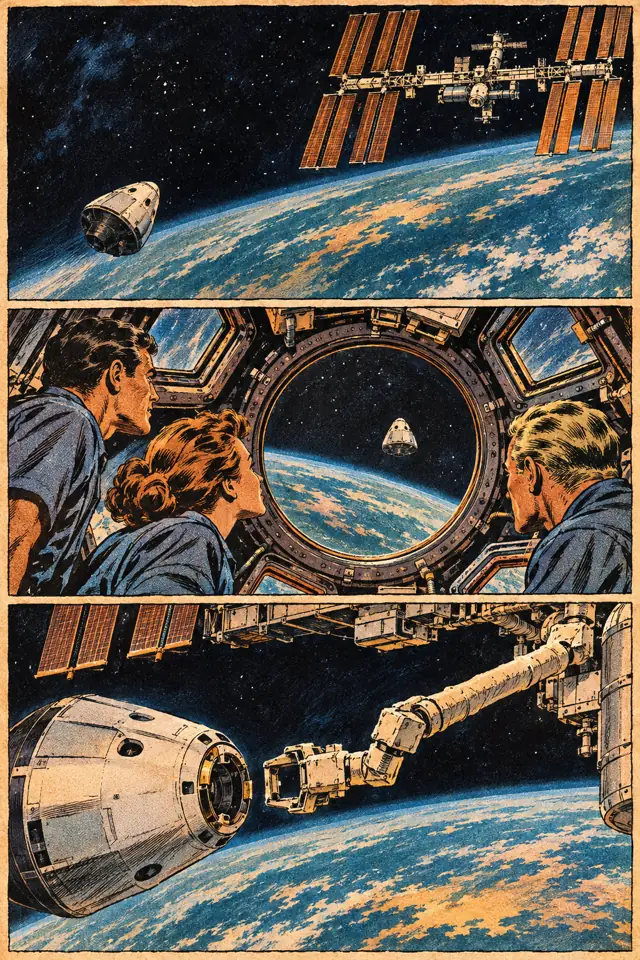
Tiny cone-shaped Dragon cargo capsule chasing space station in vast black orbit, astronauts looking through Cupola window with Earth rotating below.
31

III · Proving It · MAY 2012

Approach Slowly

Dragon's 2012 station demonstration began with launch into the station's orbital neighborhood. Getting near the ISS was not a matter of simply pointing at a visible destination.

The spacecraft had to match orbital motion, pass navigation tests, and prove it could hold position safely while ground and station teams checked its behavior.

Astronauts prepared the station's robotic arm. Mission controllers monitored every step. The approach included deliberate pauses to ensure Dragon would behave predictably.

The final meters mattered as much as the thousands of kilometers already traveled.

Field note: Key concept: orbital rendezvous requires matching trajectories and relative velocities, not just reaching the same altitude.

Page 31 of 63
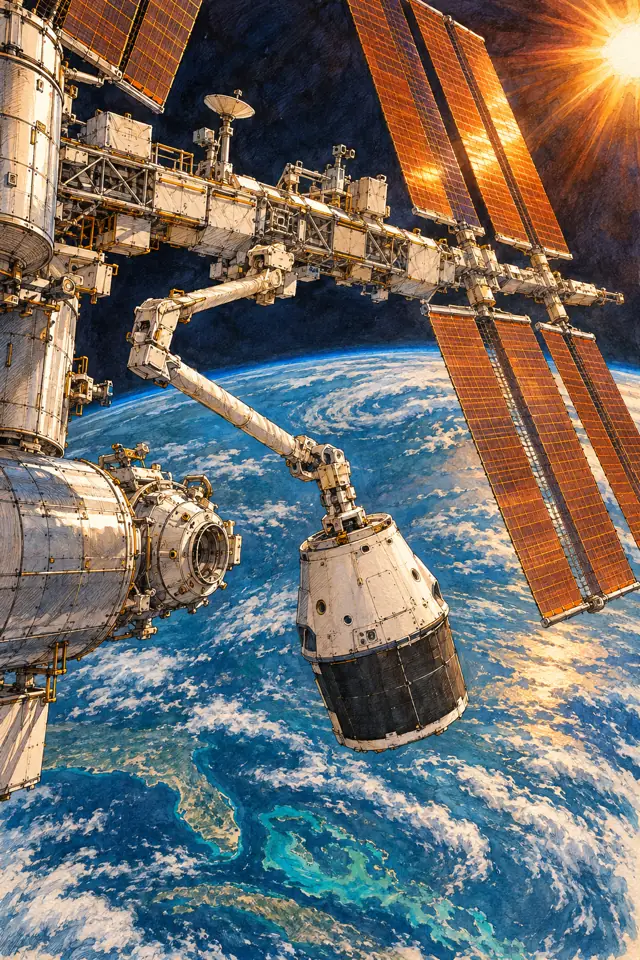
A robotic arm on the space station reaches for a cargo capsule above the Earth.
32

III · Proving It · MAY 2012

A Knock at the Station

On May 25, 2012, Dragon became the first commercial spacecraft captured and berthed to the International Space Station.

The station's robotic arm secured the capsule, and crews brought it to a docking port for cargo exchange. Dragon later returned safely to Earth with materials from orbit.

This proved the complete loop of launch, rendezvous, station service, and return. Years of NASA and industry collaboration were visible in one carefully controlled sequence.

A private company had not simply touched space. It had begun to provide a service to people already living there.

Field note: Milestone: Dragon berthing at the ISS, May 25, 2012, during the COTS demonstration.

Page 32 of 63
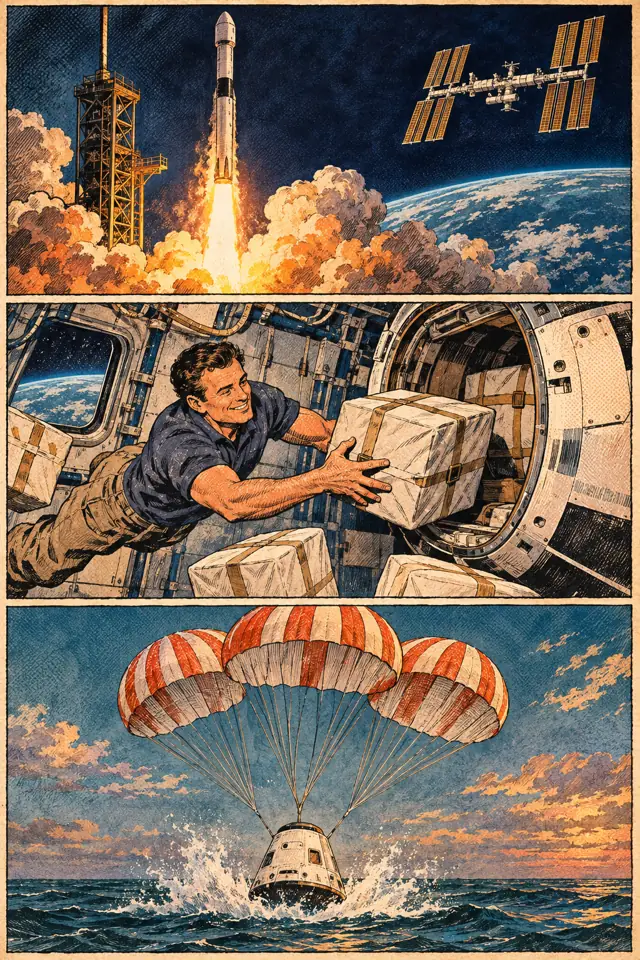
Glowing Falcon 9 launch toward ISS, astronaut floating boxes of supplies in zero gravity at station hatch.
33

III · Proving It · OCTOBER 2012

From Demonstration to Delivery

The first contracted Dragon cargo mission to the station launched in October 2012. This was different from a technology demonstration: it was a service under NASA's Commercial Resupply Services program.

A cargo flight has to transport supplies, preserve the spacecraft, arrive safely, and support the station's ongoing research. The return leg may bring experimental samples and equipment back to Earth.

SpaceX and NASA had established a new working relationship: the agency could purchase cargo services from a privately developed transport system.

That business model would influence the next decade of commercial spaceflight.

Field note: CRS-1: first contracted SpaceX cargo resupply mission launched in October 2012.

Page 33 of 63
Precision upgraded Merlin engine cluster seen from underneath, first-stage booster entering Earth's atmosphere with hot plume.
34

III · Proving It · 2013

A New Question: Why Throw It Away?

After developing a viable orbital transport business, SpaceX kept asking an uncomfortable economic question: why discard the most expensive hardware after a single flight?

Most first stages fell back into the ocean or broke apart. Recovering one would mean surviving hypersonic descent, relighting engines, steering to a target, and setting down upright without a runway.

The team built experiments into upgraded Falcon 9 hardware and carried out early controlled reentry tests. These did not guarantee a landing. They built the data needed to attempt one.

The next revolution would begin with a rocket that refused to disappear.

Field note: Reusability: a separate engineering program aimed to recover and ultimately refly orbital-class first stages.

Page 34 of 63
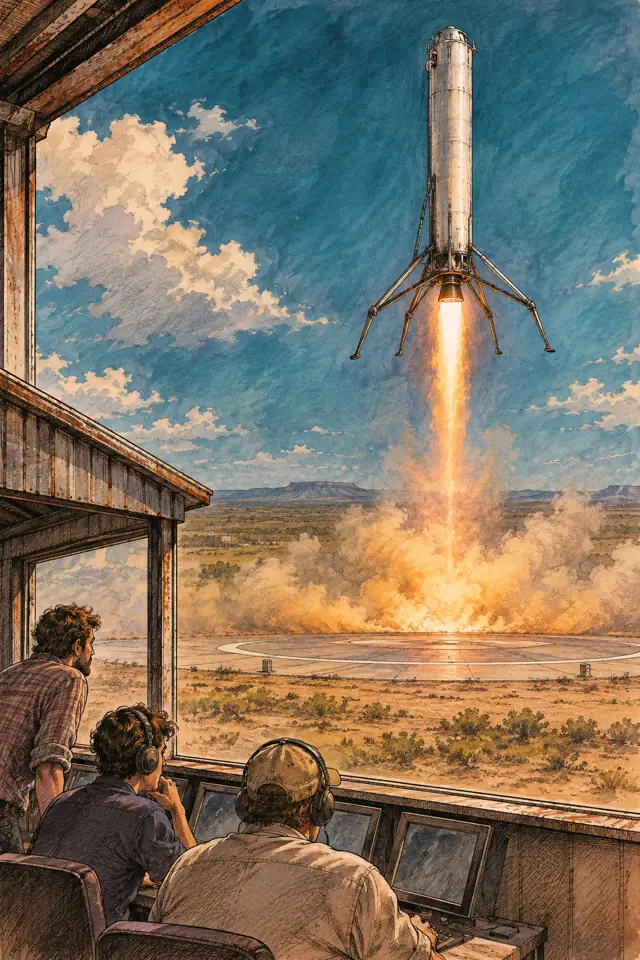
People on a viewing deck watch a test rocket hover on its engine above the desert.
35

IV · Return · 2012–2013

Grasshopper

At the McGregor test site, a strange experimental vehicle rose above a pad and settled back down on its legs. Grasshopper was a test platform for vertical takeoff, hovering, and controlled landing.

This was not yet an orbital rocket returning from space. It was a simpler environment in which to learn how engines, sensors, and control software could balance a tall vehicle against gravity.

With each hop, the team pushed higher and refined the feedback system. The vehicle looked less like a conventional discarded booster and more like a machine that could choose where to land.

A rocket was beginning to practice the art of coming home.

Field note: Grasshopper performed a series of vertical takeoff-and-landing experiments during 2012–2013.

Page 35 of 63
Long Falcon 9 first stage performing a brief vertical landing burn close to rough Atlantic waves, close landing leg actuator covered in spray and steam.
36

IV · Return · 2014

Landing Without a Runway

Falcon 9 boosters began making increasingly controlled returns toward the ocean. The open sea served as a test location while guidance, engine relighting, and landing legs matured.

A recovery attempt had to solve several problems at once. The booster fell through a changing atmosphere, corrected its path, managed dwindling fuel, and attempted a final engine burn to cancel downward speed.

Some vehicles broke up; others made better controlled descents. Both outcomes supplied information, but only recoverable hardware could ultimately reduce replacement costs.

The team learned where a falling rocket needed to be in space—and how to bring it there.

Field note: Development milestone: controlled ocean-return tests preceded successful intact booster recovery.

Page 36 of 63
Falcon 9 with Dragon lifting from Cape Canaveral into sunshine.
37

IV · Return · JUNE 2015

The Cost of Being Wrong

Even as landing experiments advanced, operational rockets were still vulnerable. In June 2015 the CRS-7 mission was lost roughly 139 seconds after launch, ending a cargo trip to the ISS before it could begin.

NASA's independent review later found a serious upper-stage oxygen-tank failure and scrutinized how a critical support component had been selected, tested, and loaded.

The accident mattered far beyond SpaceX. Customers and station operators needed confidence that corrective actions would be effective, not merely that flights could resume quickly.

Innovation did not exempt the company from the discipline of failure investigation. It made that discipline more essential.

Field note: CRS-7: June 28, 2015. NASA's independent review identified significant design and verification issues.

Page 37 of 63
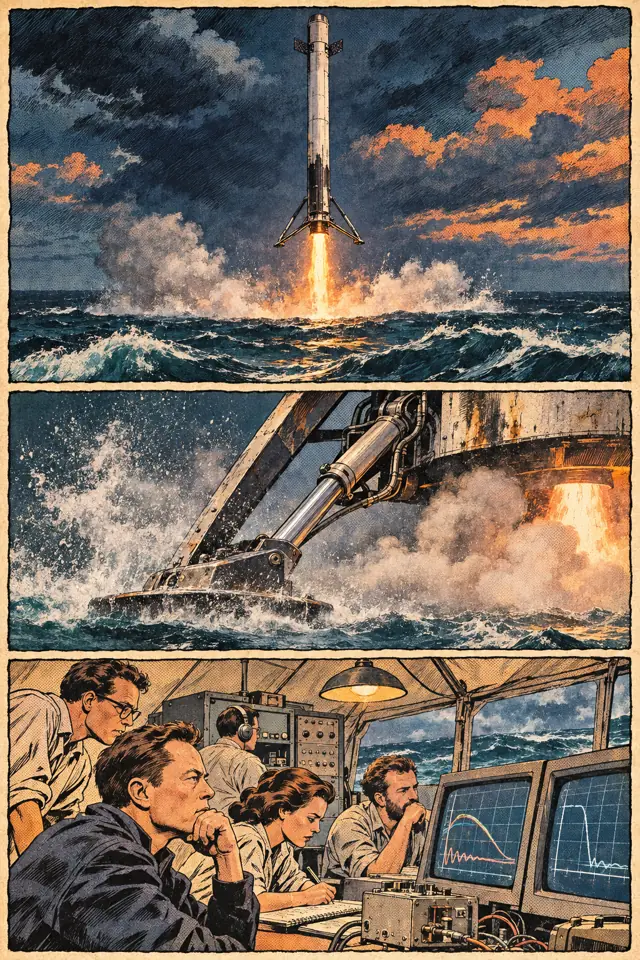
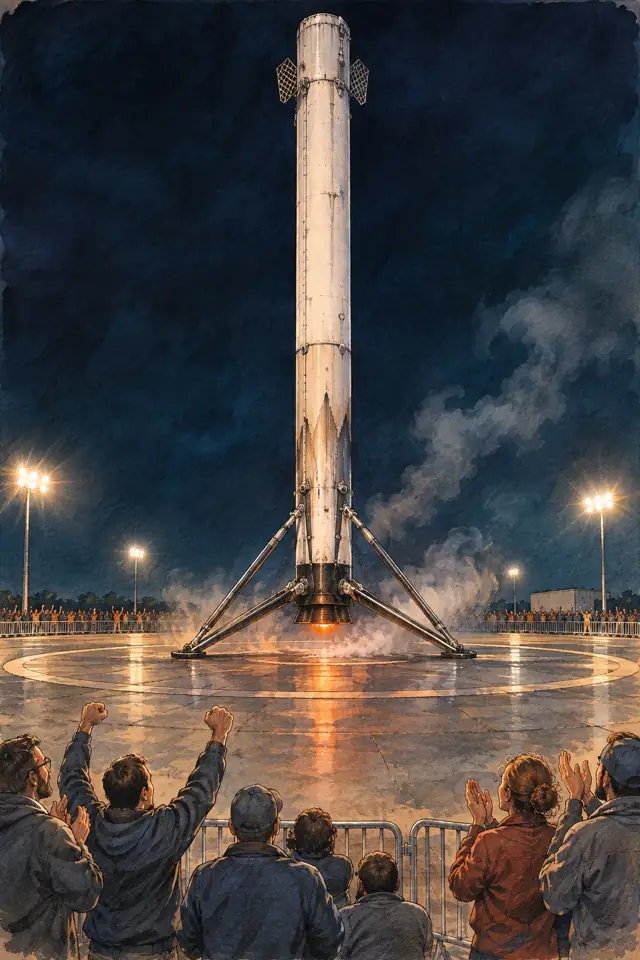
A rocket booster stands upright on a landing pad at night as a crowd cheers.
38

IV · Return · DECEMBER 2015

The First Upright Landing

On December 21, 2015, a Falcon 9 launched eleven communications satellites and sent its first stage back toward a landing zone at Cape Canaveral.

As the stage descended, guidance and engine burns slowed it down. Landing legs deployed. The booster stood upright on the ground after completing the first half of an orbital mission.

It was the first successful land landing of an orbital-class booster. The dramatic footage looked impossible only a few years earlier.

But engineers knew the next test was just as important: recovering a rocket was not the same as flying it again.

Field note: First: successful ground landing of an orbital-class first stage after launch, December 21, 2015.

Page 38 of 63
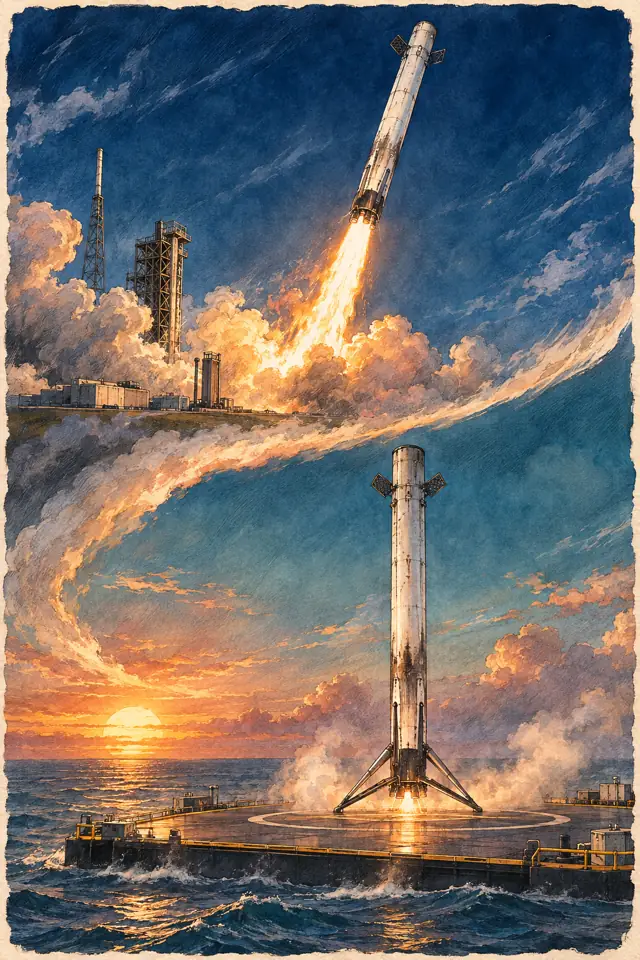
A rocket booster stands on a drone ship at sea at sunset.
39

IV · Return · APRIL 2016

A Runway That Floats

A Falcon 9 booster landed on an autonomous drone ship at sea on April 8, 2016. It was the first successful ocean-platform landing in the program.

The barge gave SpaceX a place to recover boosters on trajectories that could not conveniently return to the launch site without losing useful payload performance.

Waves, positioning, winds, and the moving maritime operation added difficulty. The landing had to be controlled from the descending rocket while the platform waited offshore.

The ocean was no longer only where boosters disappeared. It had become part of the transportation system.

Field note: First droneship landing: April 8, 2016, following a Dragon cargo launch.

Page 39 of 63
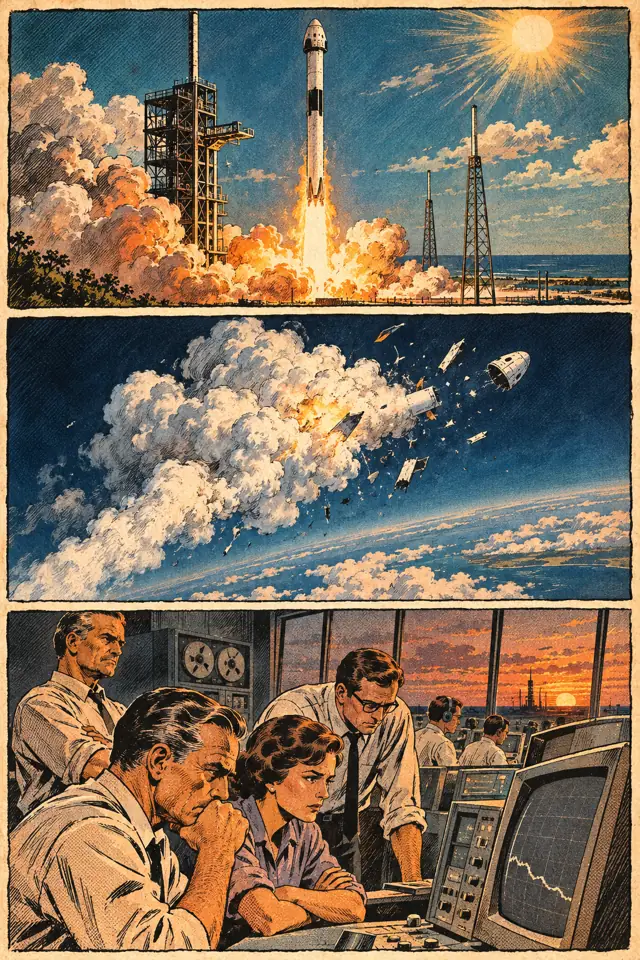
Beautiful stationary Falcon 9 on Florida pad before routine test, sudden startling enormous fireball and dark smoke rising over empty launchpad with no people nearby.
40

IV · Return · SEPTEMBER 2016

A Fire on the Pad

A Falcon 9 and its satellite payload were destroyed during a prelaunch fueling operation in September 2016. The vehicle never left the launchpad.

The loss exposed a different hazard: even before ignition, cryogenic propellants, pressurization, and mechanical systems demand strict control. Engineers investigated the failure and changed procedures and hardware.

A launch business cannot treat only flight as risky. Integration, fueling, transport, and ground testing are also phases in which expensive machines and customer payloads can be lost.

The company resumed service after another demanding investigation, but the setback remained part of the cost of learning.

Field note: AMOS-6: prelaunch pad accident, September 1, 2016. No crew was aboard.

Page 40 of 63
A rocket climbs from the coast while a used booster lands on a ship below.
41

IV · Return · MARCH 2017

Fly. Return. Fly Again.

On March 30, 2017, SpaceX launched a Falcon 9 booster that had already flown once and recovered it after the mission.

This was the real economic proof behind the landing program. A previously used first stage had performed a second orbital-class launch instead of becoming a museum piece.

Reuse still required inspection, refurbishment, scheduling, and verification. The booster had not become an airplane overnight. But the direction of travel was different from a one-use rocket.

For the first time, recovering expensive hardware could be linked directly to a second paying mission.

Field note: First reflight of an orbital-class rocket booster: March 30, 2017.

Page 41 of 63
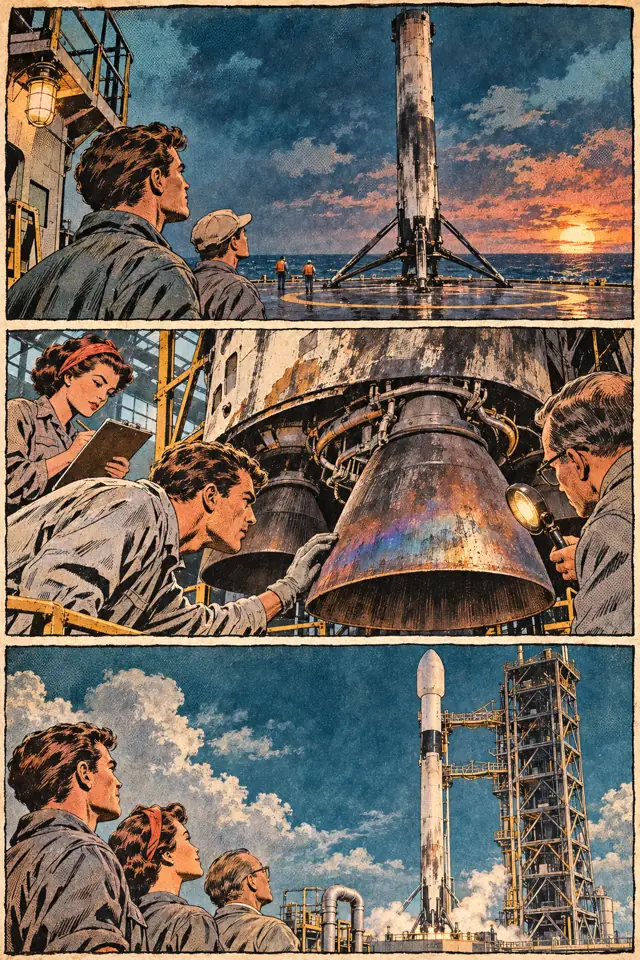
Soot-streaked flown Falcon 9 first-stage booster on four landing legs just after recovery.
42

IV · Return · 2017

How Reuse Changes the Equation

The largest visible benefit of reuse is obvious: a rocket first stage does not need to be newly manufactured for every launch. The actual economics, however, depend on how much work is required between flights.

Technicians inspect engines, structures, avionics, heat-affected surfaces, and landing hardware. A recovered booster has value only if it can be made reliably ready again at acceptable cost and on a useful schedule.

The company improved turnaround processes as flight experience accumulated. Frequent launches let engineers collect more real-world evidence and identify recurring problems faster.

Reusability was not a magic switch. It was a long campaign of making repeated flight practical.

Field note: Key distinction: landing, refurbishment, certification, and reflight are separate operational achievements.

Page 42 of 63
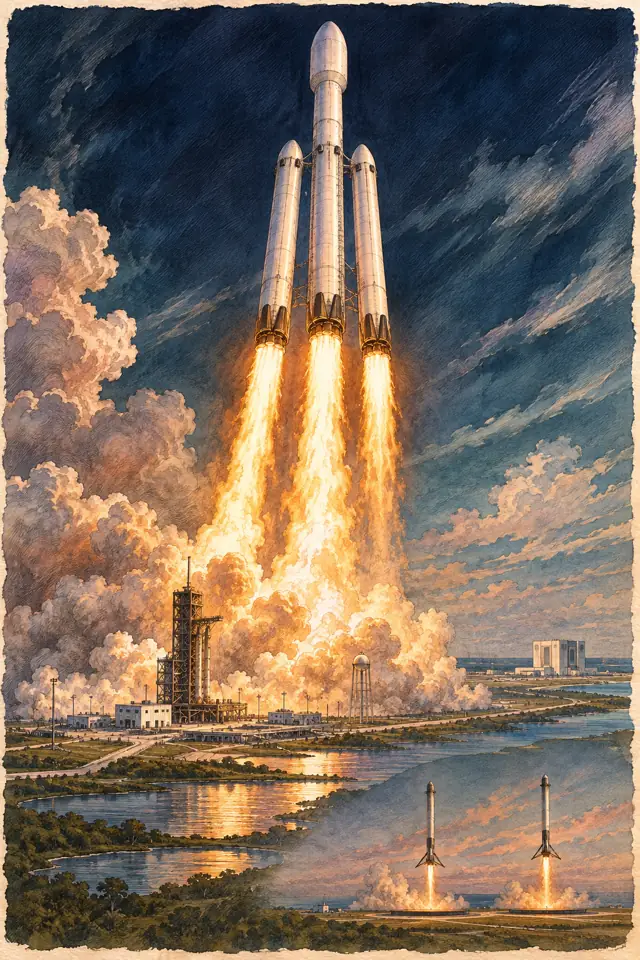
A heavy rocket with three cores lifts off, with two boosters landing in the distance.
43

IV · Return · FEBRUARY 2018

The Giant Wakes

Falcon Heavy launched for the first time on February 6, 2018. It joined three first-stage cores into one enormous rocket able to lift much heavier payloads than Falcon 9.

The maiden mission carried an unusual demonstration payload: a red sports car on an interplanetary trajectory. The spectacle attracted attention, but the engineering challenge was the launch vehicle itself.

Ignition, separation of side boosters, upper-stage operation, and recovery had to work in a new configuration.

The successful mission expanded the commercial and government launch options SpaceX could offer.

Field note: Falcon Heavy's first launch: February 6, 2018. Two side boosters landed; the center core was not recovered.

Page 43 of 63
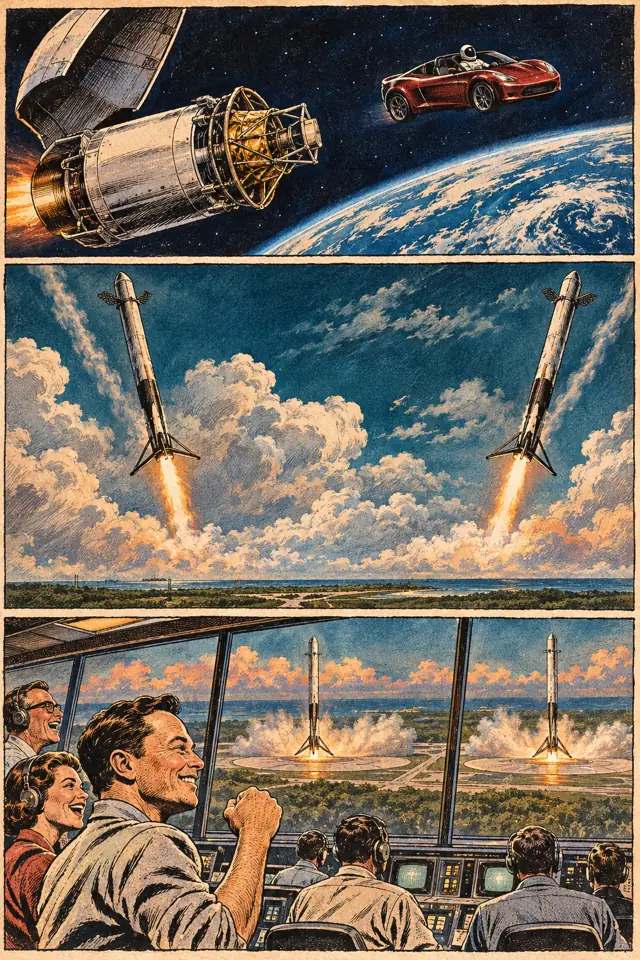
Tiny metallic red sports car payload coasting from upper stage against Earth, two massive Falcon Heavy side boosters returning from opposite sides through fluffy clouds.
44

IV · Return · 2018

Two Rockets Coming Home

While the Falcon Heavy upper stage continued its mission, the two side boosters returned toward land and touched down almost together.

Their synchronized landings made the reusability concept visually unforgettable. But the more impressive fact was operational: multiple large rocket stages had been steered home after serving one launch.

The center core did not return successfully on that first mission. The demonstration contained both a dramatic achievement and another recovery challenge.

SpaceX was learning to handle recovery as a repeatable part of launch operations, not as an isolated performance.

Field note: Maiden flight result: both side boosters recovered on land; center-core recovery unsuccessful.

Page 44 of 63
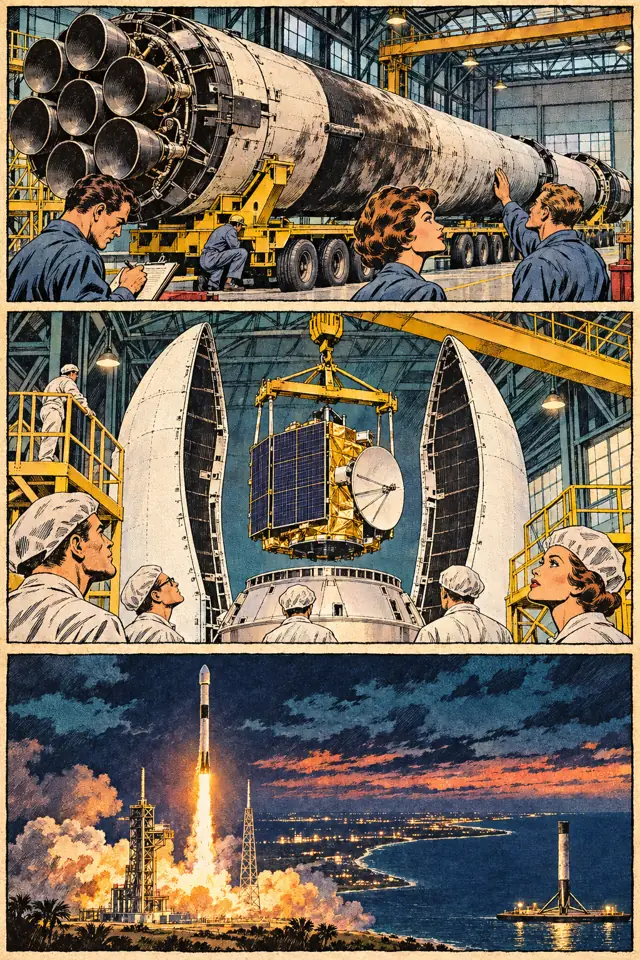
Technicians inspect rocket booster on factory transporter, massive crane transfers commercial satellite into white payload fairing.
45

IV · Return · 2018–2019

From Spectacle to Schedule

As Falcon 9 flights grew more frequent, launch operations became a continuing business. Commercial satellites, government missions, rideshares, and station supply flights required different handling and increasingly reliable schedules.

The engineering challenge broadened from making a rocket work to making a fleet work. Factories, launchpads, landing ships, recovery crews, and mission controllers had to function as one coordinated system.

A successful landing could be photographed. A dependable launch cadence was harder to show—but just as important.

The company was shifting from a sequence of extraordinary demonstrations into the infrastructure of a real space economy.

Field note: Business model: launch services for multiple customer types, supported by recurring operations and booster reuse.

Page 45 of 63
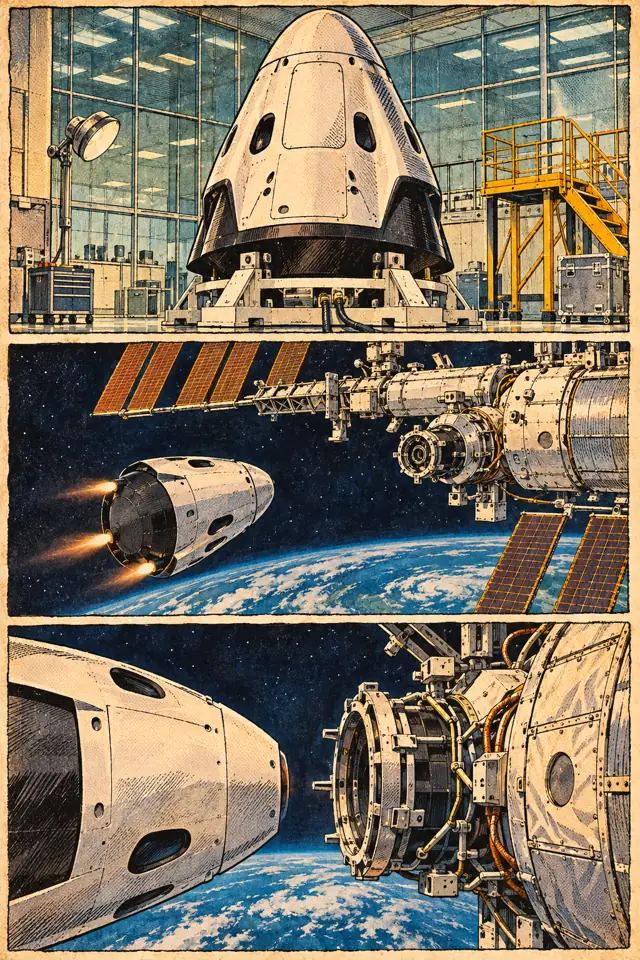
March 2019 uncrewed Crew Dragon Demo-1 autonomously docked to International Space Station.
46

V · A Working Space Economy · MARCH 2019

A Door for People

Cargo Dragon proved SpaceX could visit the station, but carrying astronauts required a new level of safety and assurance. Crew Dragon included life-support capabilities, a launch abort system, and the ability to dock autonomously.

In March 2019 an uncrewed Crew Dragon demonstration docked with the International Space Station. That test allowed NASA and SpaceX to observe the system in orbit without putting a crew aboard.

The vehicle then returned to Earth. Demonstration flights and later tests were steps toward certification, not replacements for it.

Before human beings could ride this machine, the company had to show how it would protect them when everything was normal—and when it was not.

Field note: Demo-1: uncrewed Crew Dragon docked autonomously at the ISS in March 2019.

Page 46 of 63
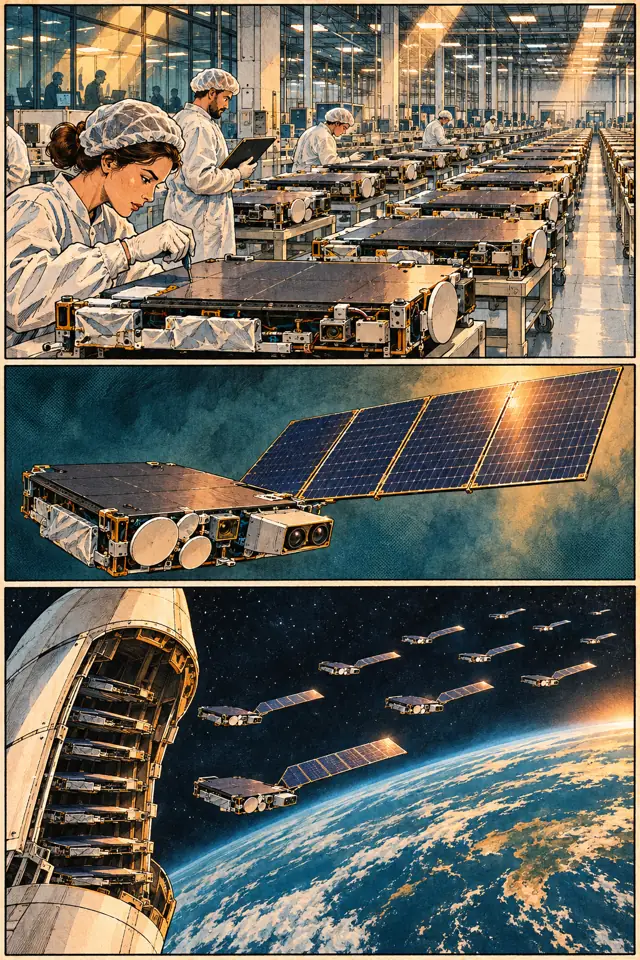
Densely packed rows of flat small satellites in sterile white factory, special panel of deployable solar array and laser-link components without technical labels.
47

V · A Working Space Economy · 2019

A Factory for Satellites

SpaceX began deploying Starlink satellites in large batches. The project used the company's launch capability to create a communications network in low Earth orbit.

Satellite manufacturing, network software, ground terminals, radio spectrum, and orbital operations became intertwined with the rocket business. Launch vehicles could carry the hardware; the network had to make it useful.

Compact satellites were stacked inside Falcon 9 payload fairings and deployed in orbit. The constellation was designed to grow over many launches rather than appearing all at once.

For the first time, SpaceX was not only transporting somebody else's infrastructure. It was building its own infrastructure in space.

Field note: Starlink: large-scale deployment began in 2019, relying on repeated Falcon 9 launches.

Page 47 of 63
2019-2020 satellite internet reaches remote customers, emotional two-panel editorial comic: quiet remote snowy farmhouse and desert medical station with a small rooftop.
48

V · A Working Space Economy · 2019–2020

A Signal Above the Clouds

A user terminal on the ground can communicate with satellites moving overhead. A low-orbit network needs many spacecraft, handoffs, and careful management to offer continuous service.

Starlink began early broadband service in 2020. Its appeal included connecting remote places where laying cable or building terrestrial networks can be difficult.

The system also raised legitimate questions: crowded orbital shells, space debris mitigation, light pollution affecting astronomy, and how to coordinate radio spectrum fairly.

The company was learning a new reality. A successful satellite network is not defined only by how many satellites it launches, but also by the service and stewardship it maintains.

Field note: Technical context: satellites in low Earth orbit move relative to users and require managed handoffs and safe operations.

Page 48 of 63
Satellites cross the night sky above the Earth, over a lit cabin in the mountains.
49

V · A Working Space Economy · 2019–2020

The Constellation

Seen from the ground, a line of fresh satellites can look like a string of stars. From orbit, it is an evolving communications system spanning many orbital planes.

Starlink tied together two SpaceX businesses: a low-cost, frequently flown rocket fleet and a communications network requiring frequent deployment and replacement hardware.

Its growth changed what spaceflight meant for customers. A launch was not the end product. Internet service in a village or a vehicle could be the end product.

But this success brought responsibilities on a planetary scale, including coordination with astronomers, regulators, and other spacecraft operators.

Field note: System note: Starlink has operated as a constellation, not one huge geostationary communications satellite.

Page 49 of 63
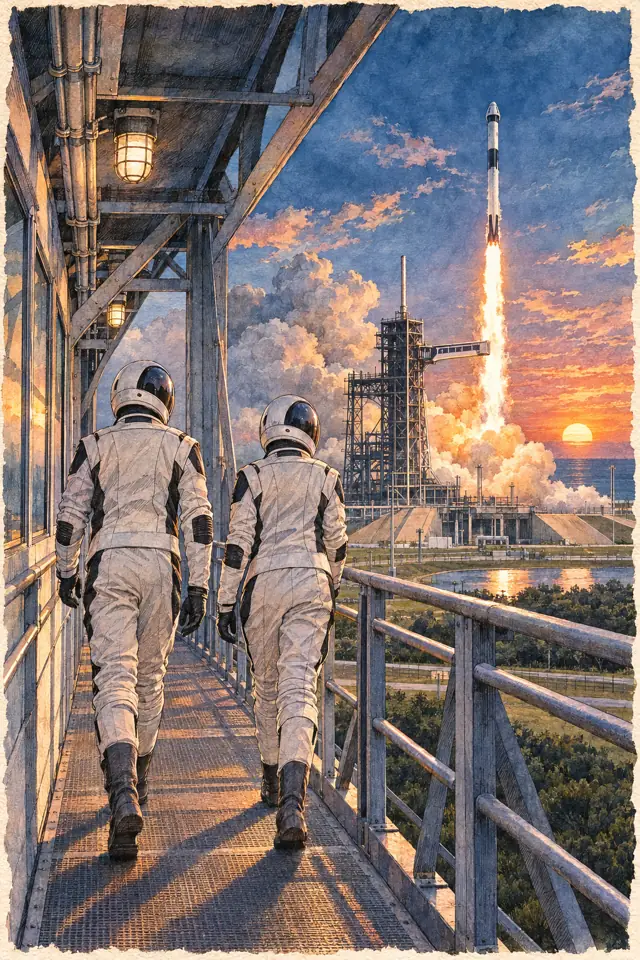
Two astronauts in white suits walk the access arm toward a rocket at sunrise.
50

V · A Working Space Economy · MAY 2020

People, Not Cargo

On May 30, 2020, NASA astronauts Bob Behnken and Doug Hurley launched from Kennedy Space Center aboard Crew Dragon on the Demo-2 test flight.

This was a profound transition. SpaceX's launch and spacecraft systems now carried people, and the mission was a central step toward the first operational NASA crew rotations on a commercial vehicle.

The astronauts approached the station, docked, and lived aboard while teams studied the spacecraft's performance.

For the first time since the Space Shuttle era, American astronauts had launched from U.S. soil on an American spacecraft—and it was operated by a commercial company.

Field note: Demo-2 launched May 30, 2020 with NASA astronauts Robert Behnken and Douglas Hurley.

Page 50 of 63
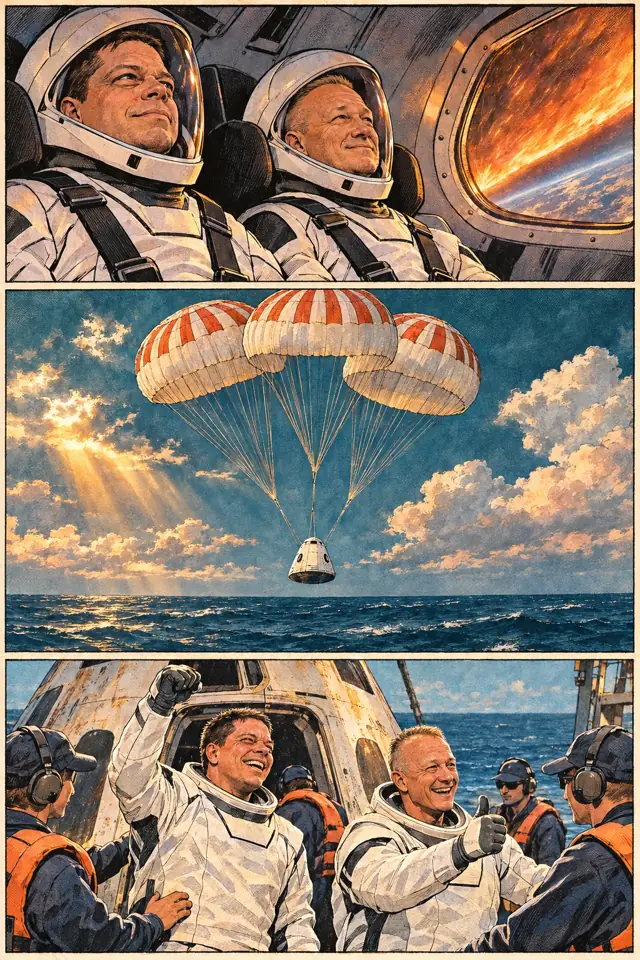
Two astronauts Bob Behnken and Doug Hurley in sleek white-and-black SpaceX suits seated inside Crew Dragon capsule under reentry glow seen through little window.
51

V · A Working Space Economy · AUGUST–NOVEMBER 2020

Bring Them Home

The human-spaceflight demonstration was not complete when the astronauts reached orbit. They had to return safely through atmospheric heating, parachute deployment, splashdown, and recovery.

Crew Dragon brought Behnken and Hurley home in August 2020. Later that year NASA certified the transportation system for operational crew missions to the station.

Crew-1 launched in November 2020, beginning regular astronaut rotation service. The agreement combined NASA oversight and mission requirements with a vehicle developed and operated by SpaceX.

The launch industry now had a new supplier of human transportation to low Earth orbit.

Field note: Demo-2 splashdown: August 2, 2020. NASA Crew-1 operational launch: November 15, 2020.

Page 51 of 63
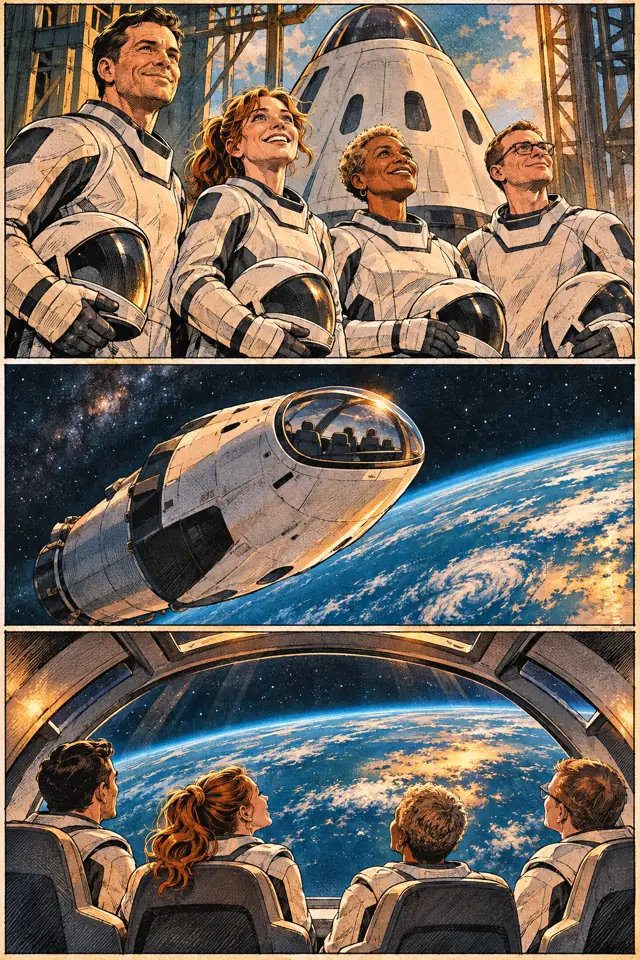
Four diverse private space travelers in white SpaceX-type suits preparing for private orbital journey.
52

V · A Working Space Economy · SEPTEMBER 2021

Four Civilians, One Orbit

Inspiration4 launched four private citizens to orbit aboard Crew Dragon, with no professional government astronaut aboard. The mission expanded the range of people who could take part in orbital spaceflight.

Their spacecraft flew for several days and returned to Earth. The trip involved rigorous preparation, safety procedures, and real physical risk—not simply a passenger ticket.

Spaceflight remained expensive and far from universally accessible. Nevertheless, the flight showed that human missions could increasingly have customers and purposes outside national astronaut corps.

What had been a government-only frontier was beginning to host a wider, though still limited, set of participants.

Field note: Inspiration4: September 2021, the first all-civilian orbital spaceflight mission.

Page 52 of 63
April 2021 NASA selects SpaceX Starship human lunar lander development.
53

V · A Working Space Economy · 2021

A Moon on the Drawing Board

Meanwhile, NASA selected SpaceX to develop a Starship-based human landing system for the Artemis lunar program. The work was a contract to design, build, test, and demonstrate a lander—not a completed Moon landing.

The concept was radically different from a small Apollo lander: a large Starship derivative with systems meant to deliver astronauts from lunar orbit to the surface and back.

This required proving much more than launch. It depended on in-space propellant transfer, cryogenic storage, docking, lunar descent, ascent, and human-rated systems.

The proposal reopened a grand destination: the Moon, with Mars still much farther beyond it.

Field note: NASA selected SpaceX for a Starship human landing system development award in April 2021; lunar flight remained future work.

Page 53 of 63
April 2022 Axiom-1 first all-private astronaut mission to ISS using Dragon, three-panel hand-drawn comic: four adult private astronauts training in spacecraft simulator.
54

V · A Working Space Economy · APRIL 2022

A New Kind of Passenger

Axiom Mission 1 carried a privately organized crew to the International Space Station aboard SpaceX Dragon. The spacecraft and launch vehicle were commercial, and the mission involved a separate private operator working with NASA.

The flight demonstrated a growing market for privately arranged orbital missions, research, and astronaut experiences beyond government crew rotation contracts.

That market came with demanding safety and station integration requirements. Each new customer still had to respect the orbital laboratory's rules and the risks of launch and return.

Commercial spaceflight was no longer just a phrase about future possibilities. Multiple organizations were now operating within it.

Field note: Axiom Mission 1 launched April 8, 2022, the first all-private astronaut mission to visit the ISS.

Page 54 of 63
White Crew Dragon in orbit over cobalt Earth, suited commercial space traveler exiting Dragon's open nose hatch while securely tethered in black starfield.
55

V · A Working Space Economy · SEPTEMBER 2024

Outside the Capsule

The Polaris Dawn mission launched a private crew on Crew Dragon and performed the first commercial spacewalk. Its specialized suits and procedures opened the hatch to the vacuum outside the spacecraft.

Working beyond a capsule is an extraordinary engineering task. Suit pressure, communications, life-support systems, exposure to space, and crew procedures must cooperate precisely.

The milestone demonstrated progress toward more ambitious commercial human spaceflight, while also showing how much testing is needed before routine space operations become possible.

For SpaceX, the challenge had moved from launching and landing people to expanding what they could safely do in orbit.

Field note: Polaris Dawn launched September 10, 2024, and included a pioneering commercial extravehicular activity.

Page 55 of 63
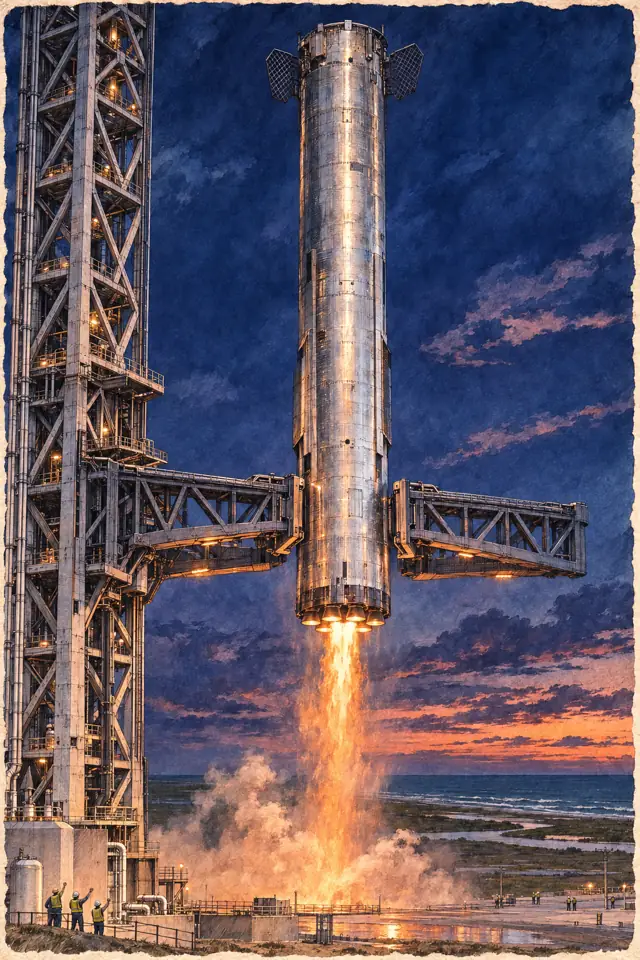
Giant stainless-steel Starship stacked on Super Heavy above Texas coast before launch, vast orange many-engine ignition and swirling smoke at liftoff.
56

VI · The Unfinished Rocket · APRIL 2023

A Rocket Bigger Than the Dream

Starship and its Super Heavy booster formed the largest launch system SpaceX had yet attempted. The design aimed for full, rapid reusability, large payloads, and eventually journeys beyond low Earth orbit.

The first integrated flight test lifted off from Starbase, Texas, in April 2023 but ended with the vehicle breaking apart after loss of control. Launch infrastructure and operations also faced intense scrutiny.

The campaign was experimental, but that did not remove the need for rigorous engineering and public-safety oversight. Each test affected hardware, people, and the surrounding environment.

The scale of the ambition had become enormous. So had the amount still left to prove.

Field note: Starship integrated Flight 1: April 20, 2023. The vehicle was lost during the test.

Page 56 of 63
A tall stainless-steel booster stands in its launch tower with the tower arms around it.
57

VI · The Unfinished Rocket · OCTOBER 2024

Catch the Booster

On Starship's fifth integrated flight test in October 2024, SpaceX used the launch tower's mechanical arms to catch a returning Super Heavy booster for the first time.

A booster that once would have fallen to the ocean instead slowed itself with rocket thrust and was captured high above the pad by the giant steel arms.

It was a spectacular recovery demonstration. But the upper stage had not yet become a regularly recovered, reused orbital spacecraft. The tower-catch system still needed repeated safe success.

The old question had returned in a much larger form: could an entire launch system be recovered rather than thrown away?

Field note: First Super Heavy tower-arm catch: Starship Flight 5, October 13, 2024.

Page 57 of 63
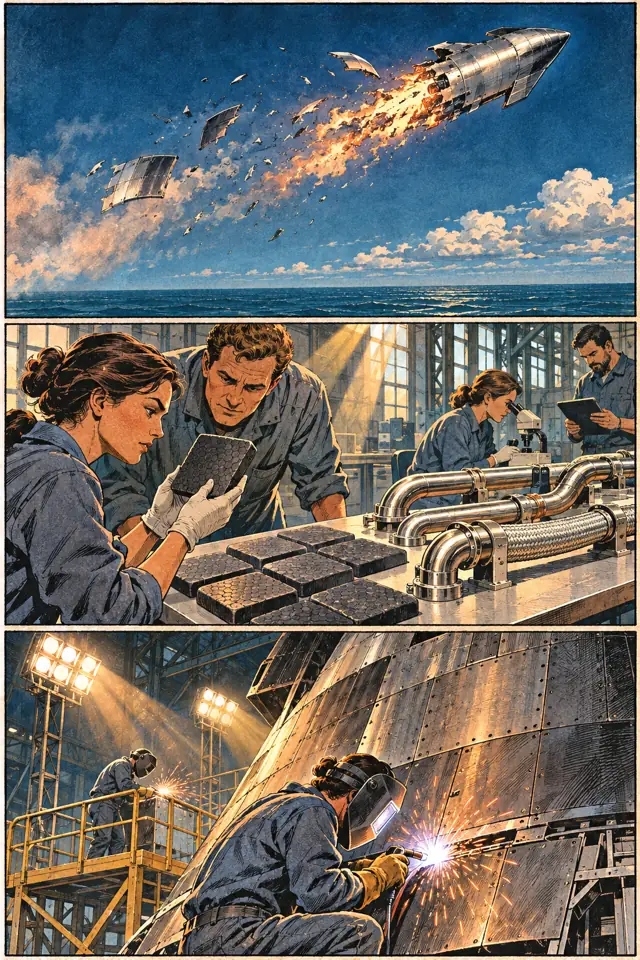
Prototype stainless steel Starship upper-stage disintegrates high over empty sea in blue atmosphere on a test flight.
58

VI · The Unfinished Rocket · 2025

The Hard Lessons Continue

The Starship test campaign did not advance in a straight line. Several 2025 flights ended with loss of upper stages or other serious anomalies, prompting investigation and corrective work.

The hazards were different from Falcon 1. A huge vehicle operating with dozens of engines and sophisticated heat protection posed complex challenges in staging, propulsion, guidance, and reentry.

Failures at this scale also required regulatory review, risk assessment, and attention to safety beyond the test site. A mistake can teach engineers something and still be costly or unacceptable.

Progress meant turning that evidence into a safer and more capable next vehicle—not merely launching again.

Field note: 2025 Starship Flights 7, 8 and 9 suffered major mishaps; testing and design revisions continued.

Page 58 of 63
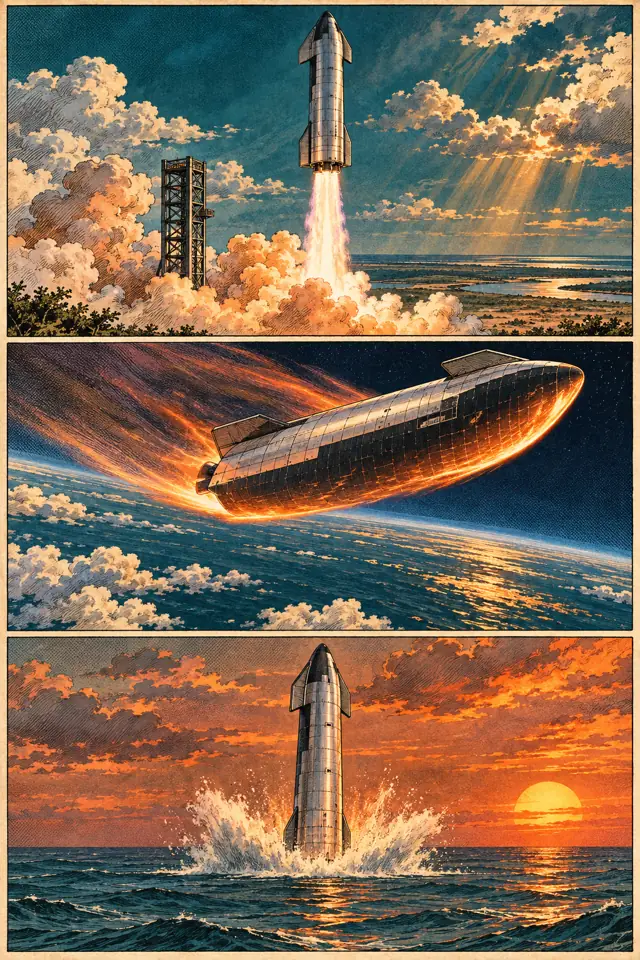
Towering stainless Starship upper-stage lifting above Texas, high-speed black belly of ship aerobraking with glowing orange plasma over Indian Ocean.
59

VI · The Unfinished Rocket · AUGUST–OCTOBER 2025

Back to the Test Range

Later 2025 tests demonstrated improved Starship performance, including lengthy powered flight, payload-deployment exercises, atmospheric reentry data, and targeted ocean splashdowns.

Controlled splashdown is not recovery for reuse. It is a valuable intermediate step: showing that the vehicle can manage its energy, orientation, and landing burn near the end of a demanding flight.

Teams measured thermal protection, flaps, engine relight behavior, and structure under severe conditions. Each result shaped the next iteration of the spacecraft.

The engineering story was still a sequence of partial victories, not the completion of a fully reusable spaceship.

Field note: Starship Flights 10 and 11 occurred in August and October 2025 and produced substantial test data.

Page 59 of 63
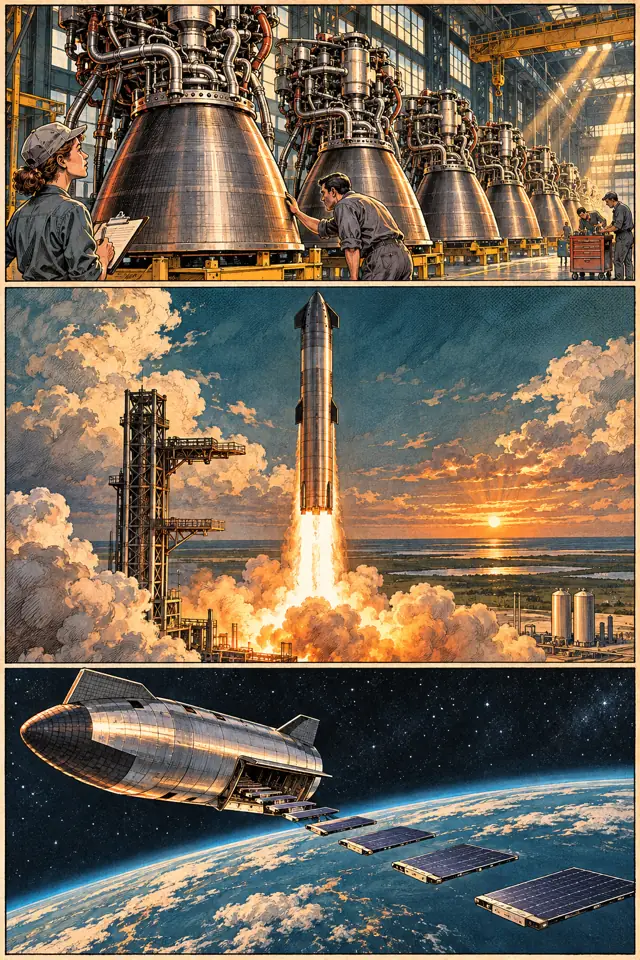
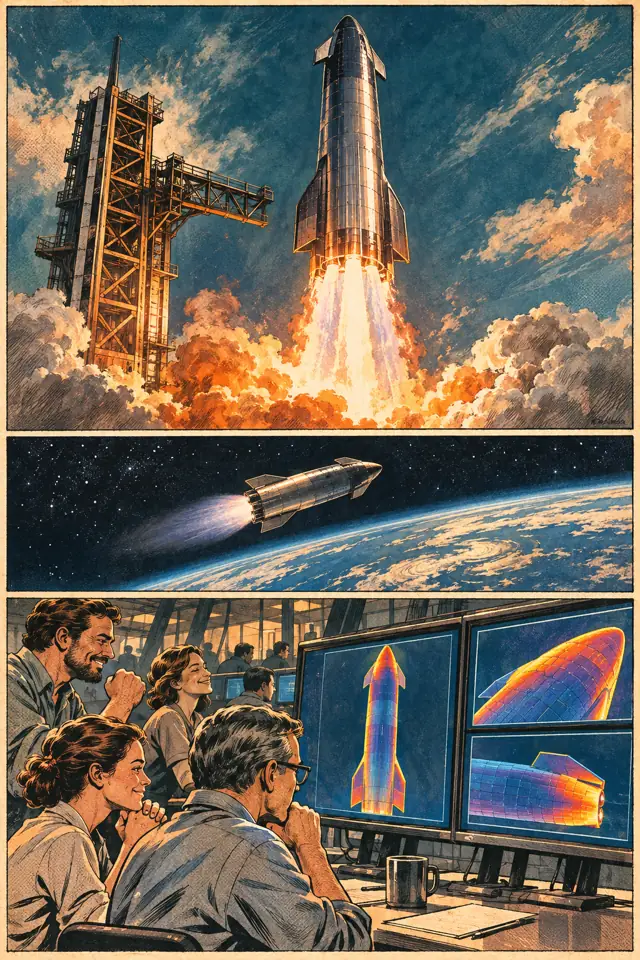
May-July 2026 first upgraded Starship V3 hardware and Raptor 3 tests.
60

VI · The Unfinished Rocket · MAY–JULY 2026

The Third Generation

SpaceX introduced upgraded Starship and Super Heavy V3 vehicles with Raptor 3 engines in 2026. The twelfth and thirteenth integrated flights tested the new hardware and deployment procedures.

Not every objective worked. The booster return sequence remained difficult, while the upper stage demonstrated important flight and reentry capabilities.

Flight 13 deployed test Starlink V3 satellites and demonstrated an in-space engine relight. The satellites were used for evaluation rather than immediately becoming an operational constellation layer.

Iteration continued, now with a much larger factory, fleet, and test program than the company that once struggled to launch Falcon 1.

Field note: Flights 12 and 13: May 22 and July 24, 2026; the campaign tested Starship V3 and Raptor 3 systems.

Page 60 of 63
September 28 2026 Starship Flight 14 first orbital attempt, three-panel vintage adventure comic: enormous Starship V3 ascending past fiery launch tower.
61

VI · The Unfinished Rocket · SEPTEMBER 2026

At Last, Orbit

On September 28, 2026, Starship Flight 14 reached Earth orbit for the first time in the vehicle's integrated flight-test campaign.

The ship completed an orbital insertion burn and deployed next-generation Starlink satellites. The mission also encountered an engine problem and was shortened from its intended plan.

That combination mattered. Spaceflight progress is often uneven: an unprecedented milestone can occur during a mission that does not meet every objective.

After years of prototypes and test flights, Starship had crossed another major threshold. But orbit was not yet the same as returning the vehicle intact and reusing it.

Field note: Starship Flight 14: September 28, 2026, first Starship orbital insertion; mission shortened after an engine issue.

Page 61 of 63
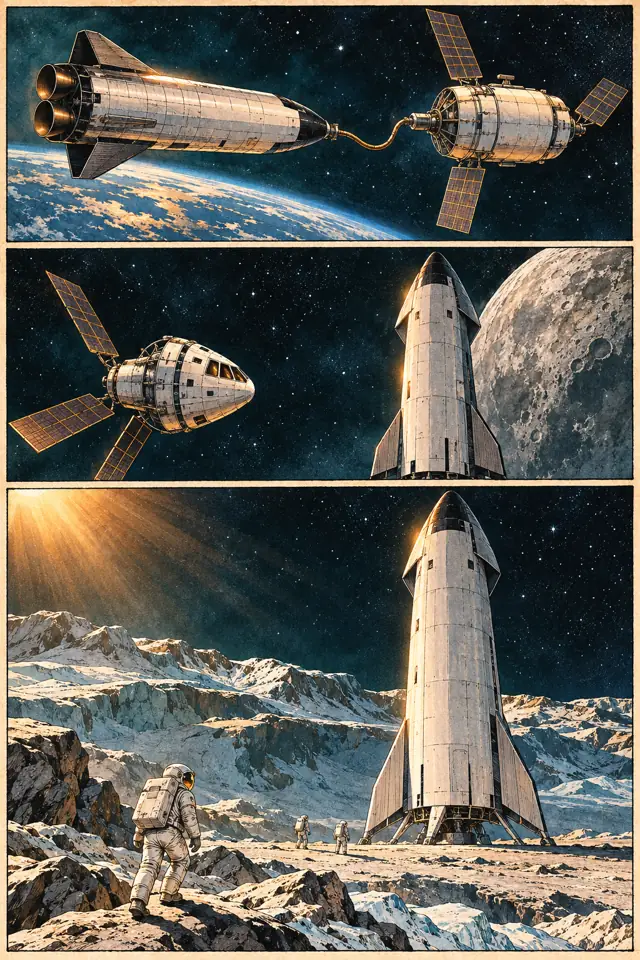
October 2026 NASA Artemis revised lunar lander plan still in development.
62

VI · The Unfinished Rocket · OCTOBER 2026

The Moon Is Still Ahead

NASA revised its Artemis mission architecture in October 2026 while continuing work with both SpaceX and Blue Origin. The agency planned an orbital demonstration of lander operations before a future lunar landing.

SpaceX's lunar Starship concept relied on transferring super-cold propellant between spacecraft in Earth orbit—a difficult operation that had not yet been proven at mission scale.

NASA had not assigned which company's lander would make the first crewed lunar landing under the revised approach. Safety, schedule, docking, life support, and rescue limitations remained serious questions.

In a story full of achievements, this destination stayed explicitly unfinished. Ambition is not a substitute for verification.

Field note: NASA update: October 23, 2026; Artemis III became an Earth-orbit test, with a crewed lunar landing targeted for 2028.

Page 62 of 63
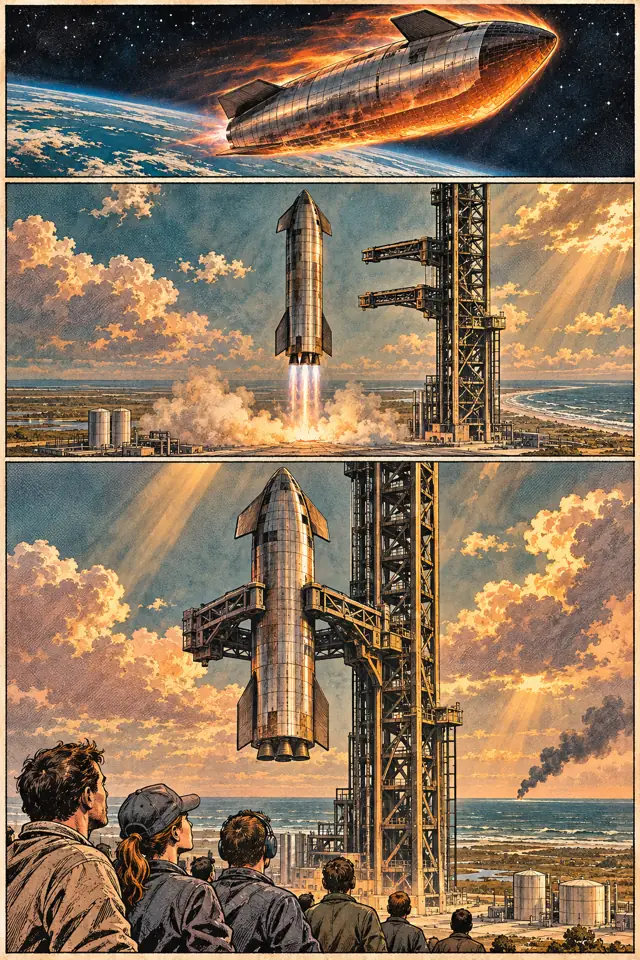
Three comic panels, stainless Starship upper-stage returning from fourteen Earth orbits with glowing orange reentry heatshield.
63

VI · The Unfinished Rocket · NOVEMBER 2026

A Ship Comes Home

Starship Flight 15 launched on November 13, 2026. Its upper stage reached orbit, deployed twenty-six Starlink V3 satellites, and spent roughly twenty-two and a half hours in space.

The next day it returned through Earth's atmosphere and was captured by the launch tower's mechanical arms: the first successful catch of a returning Starship upper stage. The planned double catch did not happen; Super Heavy's return was aborted and the booster was lost offshore.

Both truths belong in the same frame. An extraordinary new recovery milestone—and another reminder that full, routine reuse remains a work in progress.

The tiny company had become a formidable space enterprise. Its next chapters, like the first ones, still have to be earned in flight.

Field note: As of November 18, 2026: Flight 15 achieved the first Starship ship catch, while the booster was not recovered.

Page 63 of 63

You finished the series

The Impossible Engine · 6 chapters on 63 pages

  • I. Sparks
  • II. Three Fallen Falcons
  • III. Proving It
  • IV. Return
  • V. A Working Space Economy
  • VI. The Unfinished Rocket

What next

  • Post it on XOpens X with the link in a new post
  • Follow the author on X@olgunozoktas
Next guideComics
Page 1 of 63
Swipe, use the arrow keys, or tap the edge of a page to turn it

All 63 pages in one list
Read the series as one list, or pick a page to open it in the book.

  1. 1 I · Sparks · 1969–2001 The Age of Giants Human beings had stood on the Moon. That fact made the future seem limitless. Yet by the beginning of the new century, reaching orbit remained fantastically difficult, expensive, and rare. Open page›
  2. 2 I · Sparks · 2001 The Question In the early 2000s Elon Musk, already known for internet businesses, became fascinated by an uncomfortable contrast: spectacular space-age achievements and an underdeveloped path to everyday space travel. Open page›
  3. 3 I · Sparks · 2001–2002 The Arithmetic of Impossible A rocket is not a single object. It is engines, tanks, valves, software, sensors, structures, range safety systems, ground equipment, and hundreds of decisions that must work together. Open page›
  4. 4 I · Sparks · 2002 Build It Ourselves Space Exploration Technologies—soon known simply as SpaceX—was founded in 2002. Its ambition was unusually direct: make launch services less expensive and ultimately support travel beyond Earth. Open page›
  5. 5 I · Sparks · 2002 The Warehouse Early SpaceX worked in modest industrial space around El Segundo, California. Engineers unpacked tools and built up test equipment while every hour of work consumed a limited budget. Open page›
  6. 6 I · Sparks · 2002–2003 The People Behind the Fire No one person can design, test, sell, and launch a rocket. SpaceX needed propulsion specialists, machinists, software engineers, quality teams, mission planners, and people able to win customers' confidence. Open page›
  7. 7 I · Sparks · 2003 Every Bolt Counts The new team pursued extensive in-house design and manufacturing. Parts were cut, welded, inspected, redesigned, and tested within an increasingly integrated operation. Open page›
  8. 8 I · Sparks · 2003 Fire, Metal, Mathematics In McGregor, Texas, engine testing turned drawings into reality. The Merlin family would become the heartbeat of the Falcon vehicles. Open page›
  9. 9 I · Sparks · 2004–2005 An Island at the Edge of the Map Launching a new rocket required more than a workshop. It required range permissions, a remote pad, tracking, communications, weather planning, fuel handling, and an immense amount of transport. Open page›
  10. 10 II · Three Fallen Falcons · 2005 Cargo for the Edge of the World Rocket development now involved ships, cranes, containers, and logistics plans. Falcon 1 hardware traveled across the Pacific to the island launch site. Open page›
  11. 11 II · Three Fallen Falcons · 2005–2006 The First Falcon Falcon 1 was deliberately smaller than the orbital rockets of major national programs. A single Merlin engine powered its first stage; a Kestrel engine would operate the second. Open page›
  12. 12 II · Three Fallen Falcons · MARCH 2006 Ignition On the remote island, the launch team prepared for its first orbital attempt. The rocket stood exposed above the ocean while engineers watched telemetry screens from protected control positions. Open page›
  13. 13 II · Three Fallen Falcons · MARCH 2006 Thirty-Three Seconds The first Falcon 1 flight ended soon after liftoff. An engine-area fire caused loss of thrust, and the vehicle did not reach orbit. Open page›
  14. 14 II · Three Fallen Falcons · AUGUST 2006 NASA Opens a Door NASA faced a future without the Space Shuttle. Supplying the International Space Station would still be essential, and the agency wanted private industry to develop new transportation capabilities. Open page›
  15. 15 II · Three Fallen Falcons · 2006–2007 Failure Analysis Engineers compared sensor data with hardware evidence to trace the first flight's early engine failure. Repairing the visible damage would be pointless unless the design and process problem was understood. Open page›
  16. 16 II · Three Fallen Falcons · MARCH 2007 The Second Attempt On Falcon 1's second flight, the launch vehicle climbed much farther than before. Its first stage functioned long enough to carry it through the early mission. Open page›
  17. 17 II · Three Fallen Falcons · 2007 Not Yet The second mission ended short of orbit. This time SpaceX was not facing the same early fire; the later flight encountered control and stability trouble. Open page›
  18. 18 II · Three Fallen Falcons · 2007–2008 The Data Doesn't Lie Guidance systems continuously correct how a flying rocket points and rotates. Even small oscillations can grow when vehicle dynamics, changing mass, and control inputs interact. Open page›
  19. 19 II · Three Fallen Falcons · AUGUST 2008 Flight Three The third Falcon 1 had years of learning built into its materials and code. Crews checked the interfaces, rehearsed the countdown, and trusted measurements that had been earned the hard way. Open page›
  20. 20 II · Three Fallen Falcons · AUGUST 2008 The Third Fall During third-flight stage separation, the first and second stages collided, ending the mission. The failure arrived exactly where the hardware had to perform a precise choreography. Open page›
  21. 21 II · Three Fallen Falcons · 2008 One More Rocket The team investigated staging behavior, modified the next vehicle, and continued preparing an additional Falcon 1 that could fly sooner than an entirely new production campaign. Open page›
  22. 22 II · Three Fallen Falcons · SEPTEMBER 2008 Orbit On September 28, 2008, the fourth Falcon 1 reached Earth orbit. A privately developed liquid-fueled rocket had achieved something that had previously eluded comparable private efforts. Open page›
  23. 23 II · Three Fallen Falcons · SEPTEMBER 2008 A Different Sky From the ground, the rocket looked like a line of flame. From mission control, it became a sequence of numbers resolving into the one word the engineers needed: orbit. Open page›
  24. 24 III · Proving It · DECEMBER 2008 A Mission Worth Building Near the end of 2008, NASA awarded SpaceX a commercial cargo resupply contract valued at roughly $1.6 billion for twelve future space station missions. Open page›
  25. 25 III · Proving It · JULY 2009 A Real Customer in Orbit Falcon 1's fifth and final flight carried RazakSAT, a Malaysian Earth-observation satellite, into orbit. Unlike the fourth flight's test payload, this was a genuine commercial mission. Open page›
  26. 26 III · Proving It · 2009–2010 Nine Engines Falcon 9 was a major leap in size and capability. Its first stage grouped nine Merlin engines rather than the single engine of Falcon 1. Open page›
  27. 27 III · Proving It · JUNE 2010 The Bigger Falcon Flies On June 4, 2010, Falcon 9 launched for the first time and achieved orbit. The new rocket was not simply a larger Falcon 1; it had to prove that an ambitious new configuration could fly as intended. Open page›
  28. 28 III · Proving It · 2010 Building the Dragon Dragon was more than a payload container. It required navigation, communications, power, thermal protection, life-support-related design pathways, parachutes, and recovery operations. Open page›
  29. 29 III · Proving It · DECEMBER 2010 Dragon Comes Home In December 2010 Dragon launched atop Falcon 9, completed its orbital demonstration, reentered Earth's atmosphere, and splashed down in the ocean. Open page›
  30. 30 III · Proving It · 2011 After the Shuttle NASA's Space Shuttle program ended in 2011. The International Space Station did not stop needing food, equipment, research materials, and transport for its crew. Open page›
  31. 31 III · Proving It · MAY 2012 Approach Slowly Dragon's 2012 station demonstration began with launch into the station's orbital neighborhood. Getting near the ISS was not a matter of simply pointing at a visible destination. Open page›
  32. 32 III · Proving It · MAY 2012 A Knock at the Station On May 25, 2012, Dragon became the first commercial spacecraft captured and berthed to the International Space Station. Open page›
  33. 33 III · Proving It · OCTOBER 2012 From Demonstration to Delivery The first contracted Dragon cargo mission to the station launched in October 2012. This was different from a technology demonstration: it was a service under NASA's Commercial Resupply Services program. Open page›
  34. 34 III · Proving It · 2013 A New Question: Why Throw It Away? After developing a viable orbital transport business, SpaceX kept asking an uncomfortable economic question: why discard the most expensive hardware after a single flight? Open page›
  35. 35 IV · Return · 2012–2013 Grasshopper At the McGregor test site, a strange experimental vehicle rose above a pad and settled back down on its legs. Grasshopper was a test platform for vertical takeoff, hovering, and controlled landing. Open page›
  36. 36 IV · Return · 2014 Landing Without a Runway Falcon 9 boosters began making increasingly controlled returns toward the ocean. The open sea served as a test location while guidance, engine relighting, and landing legs matured. Open page›
  37. 37 IV · Return · JUNE 2015 The Cost of Being Wrong Even as landing experiments advanced, operational rockets were still vulnerable. In June 2015 the CRS-7 mission was lost roughly 139 seconds after launch, ending a cargo trip to the ISS before it could begin. Open page›
  38. 38 IV · Return · DECEMBER 2015 The First Upright Landing On December 21, 2015, a Falcon 9 launched eleven communications satellites and sent its first stage back toward a landing zone at Cape Canaveral. Open page›
  39. 39 IV · Return · APRIL 2016 A Runway That Floats A Falcon 9 booster landed on an autonomous drone ship at sea on April 8, 2016. It was the first successful ocean-platform landing in the program. Open page›
  40. 40 IV · Return · SEPTEMBER 2016 A Fire on the Pad A Falcon 9 and its satellite payload were destroyed during a prelaunch fueling operation in September 2016. The vehicle never left the launchpad. Open page›
  41. 41 IV · Return · MARCH 2017 Fly. Return. Fly Again. On March 30, 2017, SpaceX launched a Falcon 9 booster that had already flown once and recovered it after the mission. Open page›
  42. 42 IV · Return · 2017 How Reuse Changes the Equation The largest visible benefit of reuse is obvious: a rocket first stage does not need to be newly manufactured for every launch. The actual economics, however, depend on how much work is required between flights. Open page›
  43. 43 IV · Return · FEBRUARY 2018 The Giant Wakes Falcon Heavy launched for the first time on February 6, 2018. It joined three first-stage cores into one enormous rocket able to lift much heavier payloads than Falcon 9. Open page›
  44. 44 IV · Return · 2018 Two Rockets Coming Home While the Falcon Heavy upper stage continued its mission, the two side boosters returned toward land and touched down almost together. Open page›
  45. 45 IV · Return · 2018–2019 From Spectacle to Schedule As Falcon 9 flights grew more frequent, launch operations became a continuing business. Commercial satellites, government missions, rideshares, and station supply flights required different handling and increasingly reliable schedules. Open page›
  46. 46 V · A Working Space Economy · MARCH 2019 A Door for People Cargo Dragon proved SpaceX could visit the station, but carrying astronauts required a new level of safety and assurance. Crew Dragon included life-support capabilities, a launch abort system, and the ability to dock autonomously. Open page›
  47. 47 V · A Working Space Economy · 2019 A Factory for Satellites SpaceX began deploying Starlink satellites in large batches. The project used the company's launch capability to create a communications network in low Earth orbit. Open page›
  48. 48 V · A Working Space Economy · 2019–2020 A Signal Above the Clouds A user terminal on the ground can communicate with satellites moving overhead. A low-orbit network needs many spacecraft, handoffs, and careful management to offer continuous service. Open page›
  49. 49 V · A Working Space Economy · 2019–2020 The Constellation Seen from the ground, a line of fresh satellites can look like a string of stars. From orbit, it is an evolving communications system spanning many orbital planes. Open page›
  50. 50 V · A Working Space Economy · MAY 2020 People, Not Cargo On May 30, 2020, NASA astronauts Bob Behnken and Doug Hurley launched from Kennedy Space Center aboard Crew Dragon on the Demo-2 test flight. Open page›
  51. 51 V · A Working Space Economy · AUGUST–NOVEMBER 2020 Bring Them Home The human-spaceflight demonstration was not complete when the astronauts reached orbit. They had to return safely through atmospheric heating, parachute deployment, splashdown, and recovery. Open page›
  52. 52 V · A Working Space Economy · SEPTEMBER 2021 Four Civilians, One Orbit Inspiration4 launched four private citizens to orbit aboard Crew Dragon, with no professional government astronaut aboard. The mission expanded the range of people who could take part in orbital spaceflight. Open page›
  53. 53 V · A Working Space Economy · 2021 A Moon on the Drawing Board Meanwhile, NASA selected SpaceX to develop a Starship-based human landing system for the Artemis lunar program. The work was a contract to design, build, test, and demonstrate a lander—not a completed Moon landing. Open page›
  54. 54 V · A Working Space Economy · APRIL 2022 A New Kind of Passenger Axiom Mission 1 carried a privately organized crew to the International Space Station aboard SpaceX Dragon. The spacecraft and launch vehicle were commercial, and the mission involved a separate private operator working with NASA. Open page›
  55. 55 V · A Working Space Economy · SEPTEMBER 2024 Outside the Capsule The Polaris Dawn mission launched a private crew on Crew Dragon and performed the first commercial spacewalk. Its specialized suits and procedures opened the hatch to the vacuum outside the spacecraft. Open page›
  56. 56 VI · The Unfinished Rocket · APRIL 2023 A Rocket Bigger Than the Dream Starship and its Super Heavy booster formed the largest launch system SpaceX had yet attempted. The design aimed for full, rapid reusability, large payloads, and eventually journeys beyond low Earth orbit. Open page›
  57. 57 VI · The Unfinished Rocket · OCTOBER 2024 Catch the Booster On Starship's fifth integrated flight test in October 2024, SpaceX used the launch tower's mechanical arms to catch a returning Super Heavy booster for the first time. Open page›
  58. 58 VI · The Unfinished Rocket · 2025 The Hard Lessons Continue The Starship test campaign did not advance in a straight line. Several 2025 flights ended with loss of upper stages or other serious anomalies, prompting investigation and corrective work. Open page›
  59. 59 VI · The Unfinished Rocket · AUGUST–OCTOBER 2025 Back to the Test Range Later 2025 tests demonstrated improved Starship performance, including lengthy powered flight, payload-deployment exercises, atmospheric reentry data, and targeted ocean splashdowns. Open page›
  60. 60 VI · The Unfinished Rocket · MAY–JULY 2026 The Third Generation SpaceX introduced upgraded Starship and Super Heavy V3 vehicles with Raptor 3 engines in 2026. The twelfth and thirteenth integrated flights tested the new hardware and deployment procedures. Open page›
  61. 61 VI · The Unfinished Rocket · SEPTEMBER 2026 At Last, Orbit On September 28, 2026, Starship Flight 14 reached Earth orbit for the first time in the vehicle's integrated flight-test campaign. Open page›
  62. 62 VI · The Unfinished Rocket · OCTOBER 2026 The Moon Is Still Ahead NASA revised its Artemis mission architecture in October 2026 while continuing work with both SpaceX and Blue Origin. The agency planned an orbital demonstration of lander operations before a future lunar landing. Open page›
  63. 63 VI · The Unfinished Rocket · NOVEMBER 2026 A Ship Comes Home Starship Flight 15 launched on November 13, 2026. Its upper stage reached orbit, deployed twenty-six Starlink V3 satellites, and spent roughly twenty-two and a half hours in space. Open page›
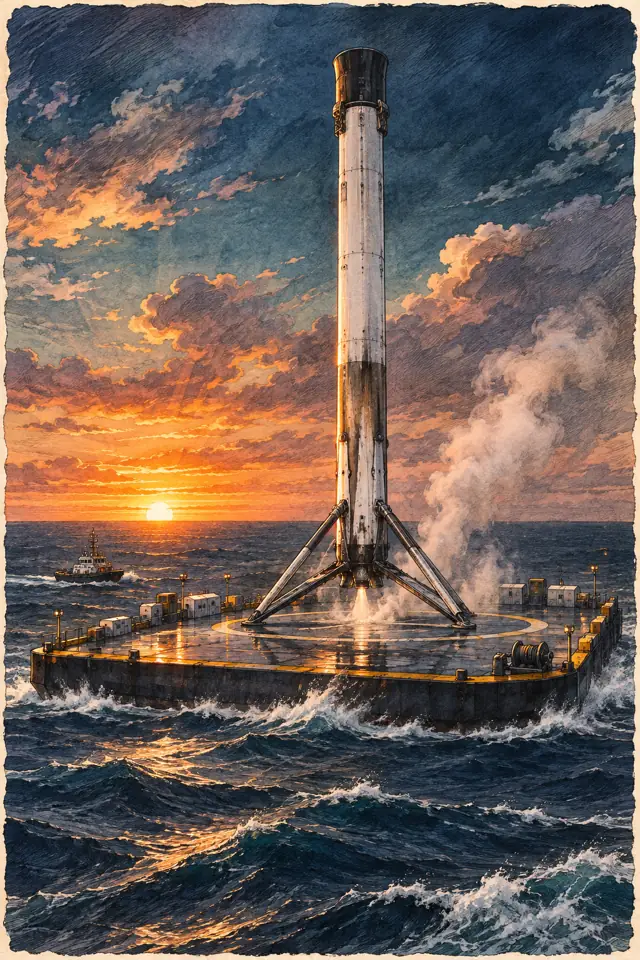
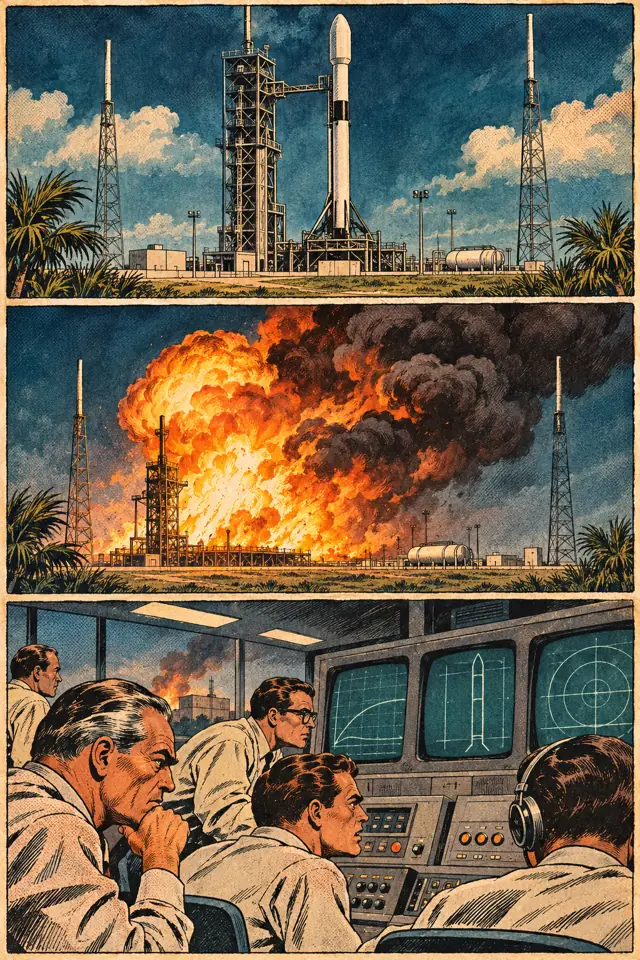
  64. ⚑ ✓ Finish You finished the series A checklist of every page and your next steps. Open the finish page›

Sources

  • NASA: Commercial Orbital Transportation Services history
  • NASA: Key SpaceX milestones and cargo press kit
  • NASA: Independent review of the 2015 CRS-7 accident
  • SpaceX: Company mission and milestone chronology
  • NASA: Demo-2 astronaut launch
  • NASA: Commercial Crew Program press kit
  • NASA: Inspiration4 and commercial human spaceflight
  • NASA: Axiom's first private ISS astronaut mission
  • SpaceX: Polaris Dawn mission record
  • NASA OIG: Human Landing System contract review, 2026
  • NASA: Updated Artemis lunar-lander plan, October 2026
  • SpaceX: Starship Flight 13 test record
  • SpaceX: Starship Flight 14 orbital test
  • SpaceX: Starship Flight 15 orbital return and ship catch
  • FAA: Starship flight safety and environmental review

From FindUtils

More to explore

Products and services from the team behind FindUtils.

Promote your tool
Just launched htmlpick.com HTMLPick — find a website template, make it your own Website themes and templates from independent creators, sorted by framework and by what you are building. Check the live preview, the license and the source before you choose. AstroHugoNext.jsJekyllSvelteHTML Browse templates Made a theme? Submit it on HTMLPick. htmlpick.com/templates Landing Portfolio Blog Docs Dashboard Starter Live preview License Source
Featured product seeranks.com SeeRanks — transparent product discovery A public ranking board where paid placement is always labeled and every product keeps its earned position. View SeeRanks Public rank board #1 Sponsored #2 #3 #4 Paid placement is always labeled Free favicon tool emojifavicons.com Emoji Favicons Turn any emoji into a favicon with one HTML line. SVG, PNG or ICO, no sign-up. <link rel="icon" href=".../🦊.svg"> Create a favicon
FindUtils service findutils.com Articles for software tools A sourced article for your channels, or a sponsored FindUtils publication with editorial review. Compare packages Domain portfolio findutils.com Domain names for sale .com.dev.sh.app.io Unused names across dev tools, AI, PDF and commerce. Make an offer. Browse the list Playable ranking towerscore.io TowerScore — stack the skyline Play to climb, or buy a floor. Paid floors are labeled. Open TowerScore

Missing a tool you need?

Tell us what to build next. Most requests ship as a free browser tool, an API endpoint and an MCP tool.

Request a tool
FindUtils

Free, fast utilities. Most tools process your files in the browser; lookup tools say what they send, and pages load analytics and ads.

  • No sign-up for free tools
  • Most tools run in your browser
  • 387 tools on the REST API, 388 on MCP

Tools

DevelopersConvertPDFDesignSecurityAll tools →

Learn

GuidesBlogComicsCheatsheetsChangelog

Build

REST APIMCP serverAPI referenceWorkflowsStatus

FindUtils

AboutLibraries we useSponsorRequest a toolDomains for saleContact
© 2026 FindUtils PrivacyTermsSitemap
Service status
FindUtils

Free, fast utilities that respect your data. Most tools run in your browser.

Build with it

REST APIMCP serverGuidesChangelog

FindUtils

AboutSponsorPrivacyContact
Theme
© 2026 FindUtils Terms
FindUtils
Guides Blog REST API MCP server Changelog

Categories

Developers 91 Convert 79 Generate 33 Calculate 32 Finance 31 Media 27
All 15 categories →

Keep it free

Sponsorship keeps every tool free and funds the new ones we ship each week.

Sponsor Back the project
Tools API Sponsor