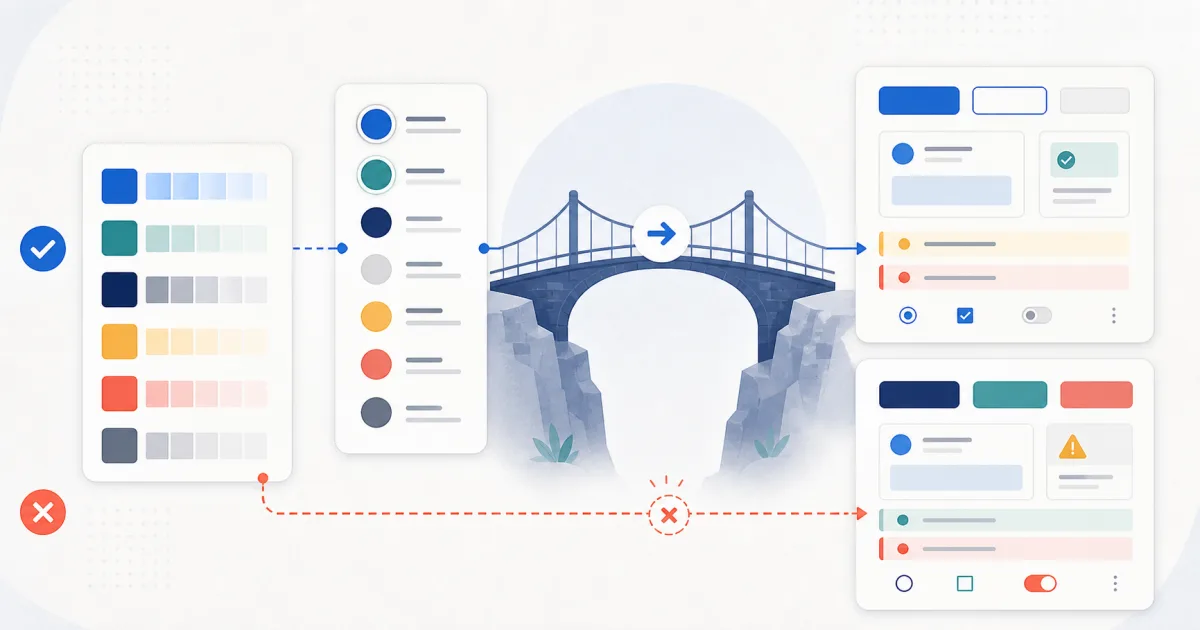
Start a Tailwind-to-StyleX migration by identifying the shared design tokens and their semantic roles. Convert static values, resolve conflicts, and review dynamic configuration separately. Token conversion does not convert component states, plugins, or responsive behavior.
Utilities Hide Two Decisions
A Tailwind class such as bg-blue-600 expresses:
- The CSS property:
background-color. - The selected design value:
blue-600.
StyleX separates those decisions. A style rule chooses the property. A constant can supply the value.
This separation is useful, but it creates a naming decision. Should a button use blue600, brand, or actionPrimary?
The answer should come from the existing design system, not from the developer converting the component.
Build a Token Inventory before Code Changes
Collect the current sources:
- Tailwind v4
@themevariables. - Tailwind config
themeandtheme.extendvalues. - CSS custom properties.
- JSON design-token files.
- Inline arbitrary values in component classes.
Choose one canonical source for each value. If --color-brand and theme.colors.brand disagree, resolve that conflict before conversion.
The Tailwind to StyleX Converter can turn the static sources into stylex.defineConsts() groups. It cannot decide which conflicting value is correct.
Preserve Semantic Roles
Palette tokens describe a color. Semantic tokens describe a job.
palette.blue600 → semantic.actionPrimary → button background
This extra layer can look verbose. It pays for itself when the brand palette changes, dark mode needs another mapping, or a warning button must stop using the primary action color.
Do not flatten semantic tokens into raw palette names during migration.
Static Parsing Is a Feature, Not a Limitation to Hide
A JavaScript configuration file can execute code. It can import plugins, inspect the environment, read files, or call other functions.
Executing an uploaded config in an online tool would be unsafe. A static converter should read data and reject code.
The FindUtils converter parses static objects, arrays, strings, numbers, CSS variables, and JSON. It warns or stops when a value needs execution.
Dynamic values then become an explicit migration task instead of hidden behavior.
What Converts Cleanly
These categories usually map well:
- Colors.
- Spacing.
- Font families.
- Font sizes and line heights.
- Font weights.
- Border radii.
- Shadows.
- Breakpoints.
- Easing values.
Simple CSS variable aliases can also resolve when both variables exist in the source.
What Needs a Separate Plan
Plugins
Plugins can generate utilities that are absent from the theme object. Inspect generated CSS or the plugin source.
Keyframes and Animations
Timing values can become constants. Keyframes and state behavior need component or animation definitions.
Arbitrary Values
Classes such as top-[13px] bypass the central theme. Decide whether the value is a deliberate exception or a missing token.
Variants
Hover, focus, group state, data attributes, dark mode, and responsive prefixes describe conditions. Token conversion does not convert those conditions into StyleX rules.
Migrate by Component Family
A large search-and-replace hides defects. Migrate a repeated family instead:
- Generate and review the token module.
- Select buttons or badges.
- Convert every state in that family.
- Compare all themes and breakpoints.
- Record any missing semantic token.
- Continue with the next family.
This method turns repeated problems into token decisions once.
Keep Tailwind during the Transition
An incremental migration can keep both systems temporarily. The key is ownership:
- New StyleX components use the generated token module.
- Existing Tailwind components keep their current classes.
- Shared semantic values have one source.
- A component does not mix both systems without a clear reason.
Remove the old path only after all consumers move and visual review is complete.
The tailwind-stylex Connection
The open-source tailwind-stylex package publishes StyleX constants for Tailwind's default design tokens. It is useful when the default scale is the intended source.
Custom product systems need their own values. The FindUtils converter creates the same kind of grouped StyleX constants from a custom Tailwind theme or design-token file. FindUtils is not affiliated with the package.
A Migration Is Complete When Intent Survives
The end state is not “there are no Tailwind classes.” The end state is:
- Shared values still have one source.
- Semantic names still describe product roles.
- Component states still behave correctly.
- Breakpoints still match the layout strategy.
- Dark mode and accessibility states still work.
- Dynamic config behavior has an explicit replacement.
Syntax is the visible change. Preserved intent is the actual result.
Try It
Open the Tailwind to StyleX Converter with a copy of your canonical theme. Review the generated groups and warnings before you edit a component.
Read the Tailwind to StyleX Guide for supported formats and the full validation checklist.