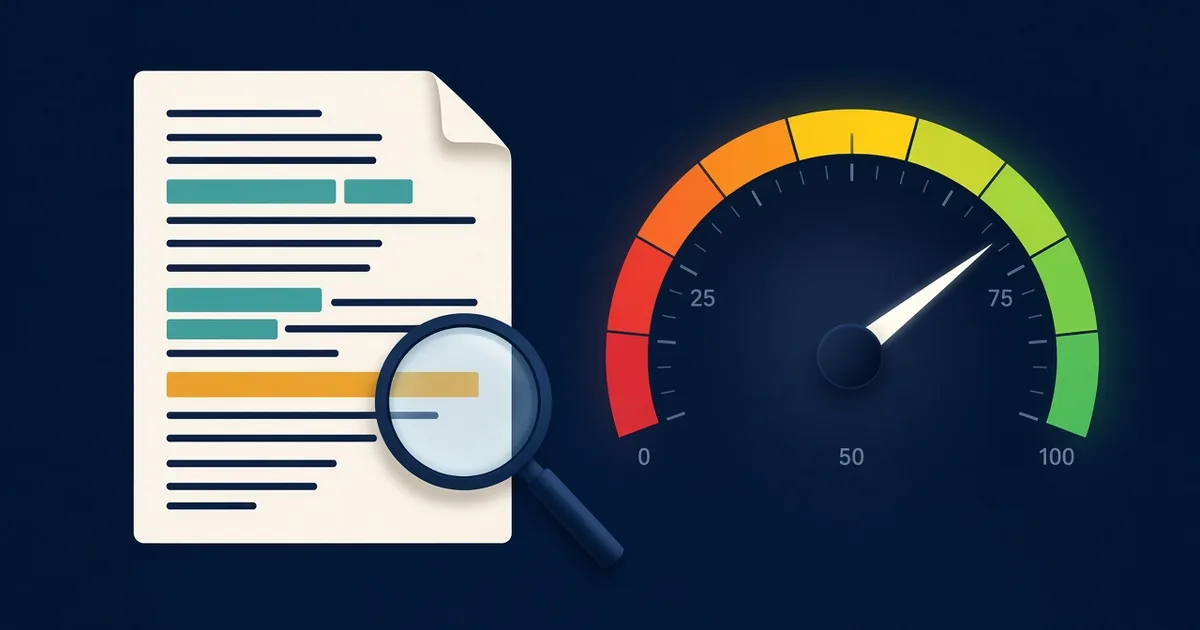
To check the reading level of a text, paste it into the FindUtils Readability Calculator. With at least 10 words and one sentence, it shows a Flesch Reading Ease score from 0 to 100 (higher is easier), five grade-level scores (Flesch-Kincaid, Gunning Fog, SMOG, Coleman-Liau and the Automated Readability Index), an Average Grade Level and a Target Audience. For most web pages and emails, aim for a Flesch score of 60 or more and a grade of about 8 or lower. The scores update as you type, the analysis runs in your browser, and there is no sign-up.
The scores only measure two things: how long your sentences are and how long your words are. That makes them good at catching long, heavy sentences, and blind to meaning, order and jargon. This guide shows how to use the tool, what each number means, a real before-and-after edit, and the cases where the numbers mislead.
How to Use the Readability Calculator, Step by Step
- Open the Readability Calculator.
- Paste your text. You need at least 10 words and one sentence before any score appears. For stable scores, use 100 words or more of normal prose.
- Check the counts first. The stats row shows Words, Sentences, Characters, Min read and Avg words/sentence. If the sentence count looks wrong, the scores will be wrong too (see the limits below).
- Read the main score. The Flesch Reading Ease card shows the score out of 100 and a label from Very Easy to Very Difficult.
- Read the grade levels. Average Grade Level and Target Audience sum up the five grade formulas, and All Readability Scores lists each one.
- Edit and watch the numbers. Shorten one long sentence or swap one long word, and the scores change straight away.
What Each Score Means
| Score | What it counts | Scale | Good target for general readers |
|---|---|---|---|
| Flesch Reading Ease | Words per sentence, syllables per word | 0 to 100, higher is easier | 60 to 70 or higher |
| Flesch-Kincaid Grade | Words per sentence, syllables per word | US school grade | about 7 to 8 |
| Gunning Fog Index | Words per sentence, share of words with 3+ syllables | Years of schooling | under 12 for a wide audience, under 8 for text almost everyone must understand |
| SMOG Index | Words with 3+ syllables per 30 sentences | US grade | about 8 or lower |
| Coleman-Liau Index | Characters per 100 words, sentences per 100 words | US grade | about 8 or lower |
| Automated Readability Index | Characters per word, words per sentence | US grade | about 8 or lower |
The Flesch label comes from the score: 90 to 100 is Very Easy, 80 to 89 Easy, 70 to 79 Fairly Easy, 60 to 69 Standard, 50 to 59 Fairly Difficult, 30 to 49 Difficult and below 30 Very Difficult. The audience comes from the average grade: up to 5 is Elementary School, up to 8 Middle School, up to 12 High School, up to 16 College, and above 16 Graduate/Professional.
The targets are not arbitrary. Microsoft's guide to Word's readability statistics says most standard files should score between 60 and 70 on Flesch Reading Ease, and around 7.0 to 8.0 on the Flesch-Kincaid grade. Some rules are written into law: Florida, for example, treats an insurance policy as readable only if it scores at least 45 on the Flesch test (Florida Statutes § 627.4145).
A Before-and-After Edit With Real Scores
Here is a refund notice written the way many policies are. It has 61 words in two sentences:
Customers who wish to request a refund for a subscription that was purchased within the previous fourteen days are required to complete the cancellation procedure through their account settings, after which the payment will be returned to the original payment method within approximately ten business days. Additional documentation may occasionally be requested by our administrative department in order to verify eligibility.
And the same information in five short sentences, 47 words:
You can get a refund within 14 days of buying a plan. Open your account settings and cancel the plan. We send the money back to the card you paid with. It takes about ten working days. Sometimes we ask for a receipt to check the date.
| Score | Before | After |
|---|---|---|
| Flesch Reading Ease | 5.3 (Very Difficult) | 89.3 (Easy) |
| Flesch-Kincaid Grade | 20.1 | 3.1 |
| Gunning Fog Index | 22 | 4.6 |
| SMOG Index | 18.8 | 5.7 |
| Coleman-Liau Index | 18.5 | 4.6 |
| Automated Readability Index | 22.1 | 2.1 |
| Average Grade Level | 18.6 (Graduate/Professional) | 4 (Elementary School) |
Two edits did almost all the work. The average sentence went from 30.5 words to 9.4, and the words the tool counts as three or more syllables went from 15 to 1. Long words such as "documentation", "administrative", "eligibility" and "approximately" became "receipt", "check" and "about". The one word left is "Sometimes", which the syllable estimate counts as three. Nothing was left out: the time limit, the steps, the refund method, the delay and the extra check are all still there.
The "before" average of 18.6 also shows how the average works. The tool only averages grade scores between 0 and 20, so Flesch-Kincaid (20.1), Fog (22) and ARI (22.1) were left out, and the average is SMOG and Coleman-Liau alone. For very hard text, look at the individual grades, not only the average.
How to Raise a Low Score
- Split long sentences. Sentence length is in every formula. If Avg words/sentence is above 20, start there.
- Swap long words for short ones where the meaning stays the same: "use" for "utilize", "help" for "facilitate", "about" for "approximately".
- Keep needed terms. A medical leaflet still has to say "antibiotic". Explain it once, in a short sentence, and keep the rest of the text simple.
- Use lists for steps. A numbered list turns one long sentence into short ones, as long as each item ends with a full stop.
- Check length too. The Word Counter and Reading Time Estimator show whether the text fits your page, and the Tone Analyzer shows whether a simpler version still sounds right.
Limits to Know Before You Trust a Score
Syllables are estimated. The tool counts groups of vowels in each word and removes common silent endings. That is fast but sometimes wrong. "Created" counts as one syllable and "idea" as two. The sentence "This sentence, taken as a reading passage unto itself, is being used to prove a point." scores 74.3 here, while the Flesch-Kincaid article on Wikipedia gives 69, because "being" is counted as one syllable instead of two. Other checkers use other rules, so the same text can score a few points apart.
Every full stop ends a sentence. A sentence ends at each ., ! or ?. "e.g.", "U.S." and "3.5" add extra sentences and make the text look easier than it is. Write "for example" and "US" before you check, or accept that the score is a little high.
The Flesch score is capped at 0 to 100. The formula itself can go above 100 ("The cat sat on the mat." gives about 116) or below 0. The tool shows 100 or 0 at the ends, so two very easy texts or two very hard texts can show the same number.
Short samples swing. SMOG was built on 30-sentence samples (McLaughlin, 1969). Below about 100 words, one long sentence can move every score a lot.
Formulas do not read. A text of short, common words can still be confusing, and a correct technical term can lower the score without making the text worse. Use the score to find heavy sentences, then decide yourself.
FAQ
What is a good readability score?
For most web pages, emails and help articles, a Flesch Reading Ease of 60 or more and a grade level of about 8 or lower. Public health and legal texts are often written for a lower grade.
How many words do I need?
The calculator needs at least 10 words and one sentence. Scores are much more stable from about 100 words, and SMOG is designed for 30 sentences.
Why does my score differ from Microsoft Word or another checker?
Each tool counts syllables, sentences and characters a little differently. The formulas are the same, but the counts they start from are not. Compare scores from the same tool only.
Does it work for languages other than English?
The formulas were made for English. For other languages, the scores give only a rough idea, because word and syllable lengths differ.
Is my text uploaded?
No. On this page, the analysis runs in your browser.
Related Reading
Sources
- Microsoft Support: Get your document's readability and level statistics (Flesch formulas and target ranges)
- Kincaid, Fishburne, Rogers and Chissom (1975): Derivation of new readability formulas for Navy enlisted personnel, Research Branch Report 8-75
- McLaughlin, G. H. (1969): SMOG Grading, a New Readability Formula, Journal of Reading 12(8)
- Florida Statutes § 627.4145: Readable language in insurance policies
- Wikipedia: Flesch-Kincaid readability tests, Gunning fog index, Coleman-Liau index and Automated readability index