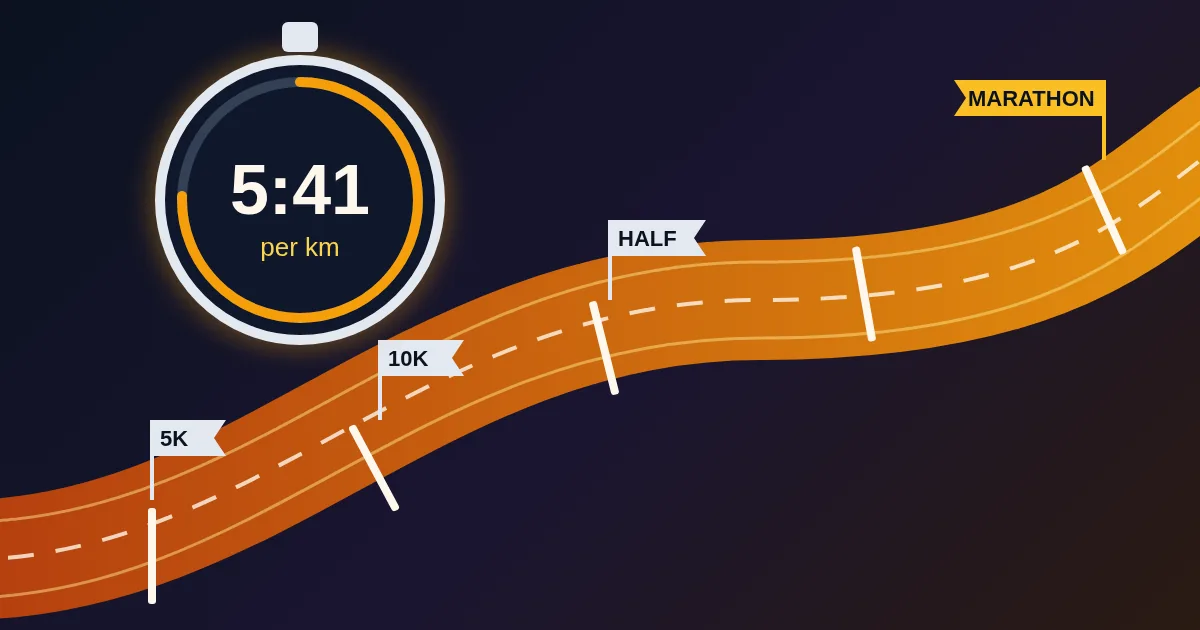
Running pace is time divided by distance: 50 minutes for 10 kilometres is a pace of 5:00 per kilometre. The FindUtils Running Pace Calculator works that sum in any direction. Give it two of distance, finish time and pace, and it solves for the third, then shows what your pace means for a 5K, a 10K, a half marathon and a marathon. It works in kilometres or miles and runs in your browser with no sign-up.
This guide covers the three modes, the input formats, a pace chart, how to plan a goal time, and why the race projections are optimistic for longer races.
The Three Things You Can Solve For
Pace, distance and time are three views of the same run. Pick which one you want with the Solve for buttons, and only the other two fields stay on screen.
| Solve for | You enter | Example | Result |
|---|---|---|---|
| Pace | Distance and time | 10 km in 50:00 | 5:00 /km, 12 km/h |
| Time | Distance and pace | 5 km at 6:00 /km | 30:00 |
| Distance | Time and pace | 45:00 at 5:30 /km | 8.18182 km |
The formulas behind each mode are the plain ones: pace = time ÷ distance, time = pace × distance, distance = time ÷ pace. When you solve for pace, the result also shows your average speed (12 km/h above), which is the number a treadmill displays.
How to Use the Pace Calculator
Step 1Choose What to Solve For
The tool opens in Pace mode with 10 km and 50:00 filled in, so you see a result straight away: 5:00 per kilometre.
Step 2Pick Kilometres or Miles
The Kilometres / Miles switch sets the unit for both the distance and the pace. Switching does not convert the numbers you typed: a distance of 10 stays 10, so 10 km becomes 10 miles. Change the unit first, then enter your values.
Step 3Enter the Two Known Values
The time and pace fields accept three formats:
| You type | Read as |
|---|---|
25:30 | 25 minutes 30 seconds |
1:25:30 | 1 hour 25 minutes 30 seconds |
90 | 90 minutes (a plain number means minutes) |
Pace is always minutes and seconds per kilometre or per mile, like 5:41. The plain-number rule applies to pace too, so 6 means 6:00 per unit. If a value cannot be read, a red box explains the format instead of a result.
Step 4Read the Result and the Race Times
The big number is the value you solved for. Below it, At this pace lists the finish times for 5K, 10K, half marathon (21.0975 km) and marathon (42.195 km) if you held that exact pace the whole way.
Step 5Export If You Want a Copy
The export button saves the race times as CSV or JSON, or opens the print dialog, which is handy for a pace band or a training log.
Pace Chart: Kilometres, Miles and Race Times
Every row below comes from the calculator: enter the pace in km mode and read the race times. The per-mile column is the same pace × 1.609344, the exact number of kilometres in a mile.
| Pace /km | Pace /mile | Speed | 5K | 10K | Half marathon | Marathon |
|---|---|---|---|---|---|---|
| 4:00 | 6:26 | 15.0 km/h | 20:00 | 40:00 | 1:24:23 | 2:48:47 |
| 4:30 | 7:15 | 13.3 km/h | 22:30 | 45:00 | 1:34:56 | 3:09:53 |
| 5:00 | 8:03 | 12.0 km/h | 25:00 | 50:00 | 1:45:29 | 3:30:59 |
| 5:30 | 8:51 | 10.9 km/h | 27:30 | 55:00 | 1:56:02 | 3:52:04 |
| 6:00 | 9:39 | 10.0 km/h | 30:00 | 1:00:00 | 2:06:35 | 4:13:10 |
| 6:30 | 10:28 | 9.2 km/h | 32:30 | 1:05:00 | 2:17:08 | 4:34:16 |
| 7:00 | 11:16 | 8.6 km/h | 35:00 | 1:10:00 | 2:27:41 | 4:55:22 |
The race distances are fixed by World Athletics: the marathon has been 42.195 km (26 miles 385 yards) since 1921, a length first run at the 1908 London Olympics, and the half marathon is exactly half of that.
Planning a Goal Time
To find the pace for a target, solve for Pace with the race distance and the goal time.
Example: a sub-4-hour marathon. Enter 42.195 km and 4:00:00. The pace is 5:41 per kilometre (10.55 km/h). In miles mode, 26.2188 miles in 4:00:00 gives 9:09 per mile.
Now check the rounding. Switch to Time, keep 42.195 km and enter the pace 5:41. The finish is 3:59:48, so 5:41 really is under four hours. At 5:42 it is 4:00:31, just over. One second per kilometre is worth about 42 seconds over a marathon, which is why the tool's FAQ warns that feeding a rounded pace back in lands a little either side of where you started.
The same logic works for any goal:
| Goal | Distance | Pace needed (/km) | Pace needed (/mile) |
|---|---|---|---|
| 30-minute 5K | 5 km | 6:00 | 9:39 |
| 1-hour 10K | 10 km | 6:00 | 9:39 |
| 2-hour half marathon | 21.0975 km | 5:41 | 9:09 |
| 4-hour marathon | 42.195 km | 5:41 | 9:09 |
A 2-hour half and a 4-hour marathon need the same pace, because the marathon is exactly twice the distance. Holding it for twice as long is the hard part, which leads to the next section.
Why the Race Projections Are Optimistic
The At this pace list holds your pace constant, which the tool's FAQ calls "a straight extrapolation, not a physiological model". Real runners slow down as races get longer.
The best-known way to model that is Peter Riegel's endurance formula, first proposed in Runner's World in 1977 and expanded in American Scientist in 1981. It is usually written as T2 = T1 × (D2 ÷ D1)^1.06. The exponent is a "fatigue factor": Riegel found about 1.08 for world-class runners and 1.05 to 1.06 for male runners aged 40 to 70. Here is a 25:00 5K projected three ways:
| Race | Constant pace (the calculator) | Riegel, exponent 1.06 | Riegel, exponent 1.08 |
|---|---|---|---|
| 5K | 25:00 | 25:00 | 25:00 |
| 10K | 50:00 | 52:07 | 52:51 |
| Half marathon | 1:45:29 | 1:55:00 | 1:58:22 |
| Marathon | 3:30:59 | 3:59:47 | 4:10:14 |
Even Riegel's formula is generous at the marathon. A 2016 study of recreational runners in BMC Sports Science, Medicine and Rehabilitation (Vickers and Vertosick) found it well calibrated up to the half marathon but predicting marathon times at least 10 minutes too fast for about half of the runners.
The practical rule: use the projections to see what a pace means, and use a recent race at a similar distance to decide what pace you can hold.
Everyday Uses
- Reading a treadmill. Treadmills show speed. 10 km/h is 6:00 per kilometre and 12 km/h is 5:00. To convert any speed, solve for Pace with the speed as the distance and
60:00as the time: 12 km in 60:00 is 5:00 per kilometre. - Planning a long run. Solve for Time with the distance and an easy pace to know how long to block out. 18 km at 6:30 per kilometre is 1:57:00.
- Checking a watch. GPS distance drifts a little. If your watch says 10.2 km for a measured 10 km course, enter the official distance and your time to get your true pace.
- Run-walk or time-boxed runs. Solve for Distance with the time you have and your usual pace: 1 hour at 6:00 per kilometre covers 10 km.
Pairing It With Other Tools
- Convert odd distances (yards, metres, a 15-mile long run in km) with the Unit Converter.
- Time intervals and repeats with the Stopwatch.
- Work out the gap between two clock times, such as a start and finish time, with the Time Difference Calculator.
- Estimate how much more energy a training block needs with the TDEE Calculator and the Calorie Calculator; the TDEE guide explains activity levels.
Common Mistakes to Avoid
Mistake 1: Switching Units After Typing
The unit switch relabels your numbers; it does not convert them. A 5 km distance becomes 5 miles. Pick the unit first.
Mistake 2: Typing a Pace as Decimal Minutes
5.5 means five and a half minutes, which is 5:30, not 5:50. Use the colon format when in doubt.
Mistake 3: Treating the Marathon Projection as a Prediction
Your 5K pace held for 42 km is the best case, not a forecast. As shown above, a 25:00 5K runner's constant-pace marathon is 3:30:59, while Riegel's formula suggests about four hours.
Mistake 4: Forgetting the Exact Race Distance
A "5K" in miles mode is 3.107 miles, not 3.1. Enter 3.1 miles in 30:00 and the pace is 9:41 per mile, which projects a 5K of 30:04. For races, use the exact distance: 3.10686, 6.21371, 13.1094 or 26.2188 miles.
FAQ
How do I calculate my running pace?
Divide your time by your distance. 50 minutes for 10 km is 5 minutes per kilometre. In the calculator, choose Pace, enter the distance and the time, and the pace and average speed appear.
What pace do I need for a 4-hour marathon?
5:41 per kilometre or 9:09 per mile. At 5:41 per kilometre the finish is 3:59:48; at 5:42 it is 4:00:31.
How do I convert pace per kilometre to pace per mile?
Multiply the pace by 1.609344, the number of kilometres in a mile. 5:00 per kilometre is 8:03 per mile, and 6:00 per kilometre is 9:39 per mile. To go the other way, divide by 1.609344.
What time formats does the pace calculator accept?
mm:ss (25:30), h:mm:ss (1:25:30), or a plain number read as minutes (90 is an hour and a half).
Are the race time projections accurate?
They assume you hold the same pace for every distance. That is exact arithmetic but optimistic for longer races, especially the marathon. Riegel's formula adds a fatigue factor, and research shows even it tends to be too fast for many recreational marathon runners.
Is the Running Pace Calculator free?
Yes. It is free, needs no account, and the calculation runs in your browser.
Related Reading
Sources
- World Athletics: Marathon (26 miles 385 yards, 42.195 km, standardised in 1921)
- Riegel, P. S. (1981), "Athletic Records and Human Endurance", American Scientist 69(3): 285-290 (PubMed record)
- Wikipedia: Peter Riegel (race time prediction formula)
- Vickers and Vertosick (2016), "An empirical study of race times in recreational endurance runners", BMC Sports Science, Medicine and Rehabilitation
- Wikipedia: Half marathon (21.0975 km, 13.1094 miles)
- Wikipedia: Mile (1 international mile = 1.609344 km)