TIFF is the Tagged Image File Format, a container standardised as TIFF 6.0 in 1992 that scanners, fax servers, and image editors still write today. Windows and macOS open it, but web forms, messaging apps, and social networks mostly refuse it. TIFF to JPG decodes a .tif or .tiff file inside your browser and writes one JPG, PNG, or WebP per page, and nothing is uploaded.
Your scanner writes .tif. The upload form wants .jpg. Conversion time depends on the file, decoder, and available memory.
Tool: TIFF to JPG
When conversion helps
Convert a TIFF when the receiving form or application requires a different image format. Confirm its accepted formats and size limit before changing the file.
A 2480 by 3508 RGB image needs 26,099,520 bytes for three uncompressed color bytes per pixel. This excludes TIFF structure and metadata. Compression, color depth, and page count change the actual file size.
A JPG conversion can reduce the file size, but this guide gives no fixed reduction or timing claim. Compare the actual output with the destination's requirements.
How to convert the file
- Open TIFF to JPG
- Drop one
.tiffile or a whole batch - Download the JPG, or a zip if there is more than one output
Conversion starts the moment you drop, and the files are converted one after another. Quality defaults to 90. JPEG output can still lose detail at this setting. If you want PNG or WebP instead, open Options and pick one; the JPEG quality slider runs from 40 to 100 and does nothing when the output is PNG.
The decode runs in your browser tab with UTIF, the JavaScript TIFF decoder written for Photopea. The pixels are painted onto a canvas and re-encoded there. The converter does not upload the selected file. It loads JavaScript decoder resources when needed.
What happens to your metadata
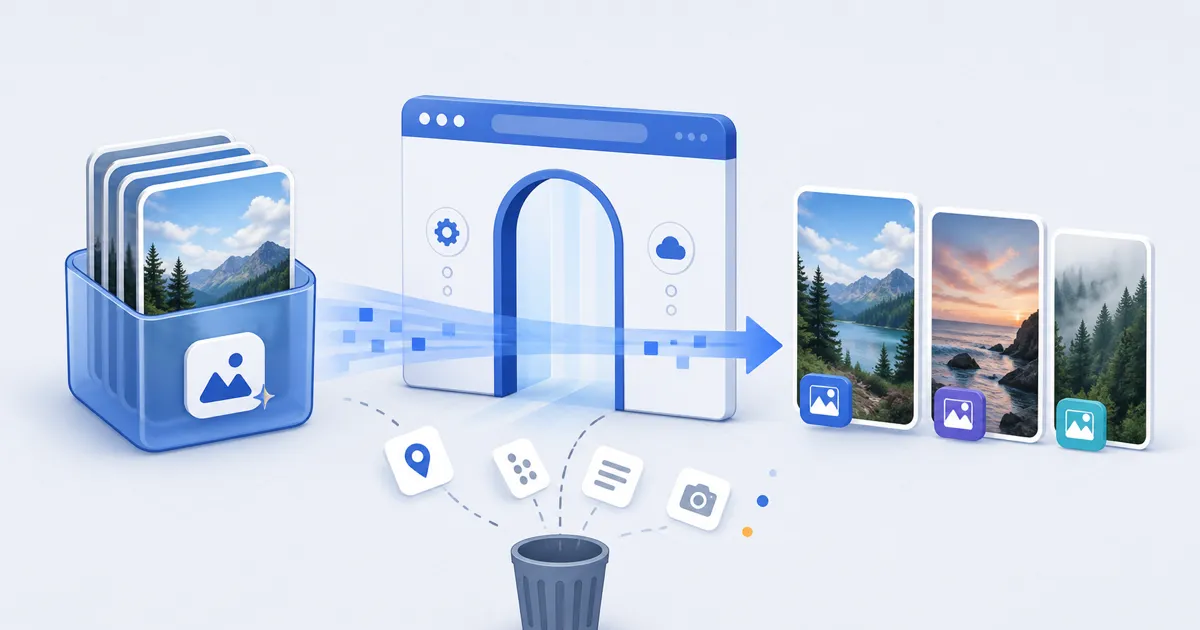
The converter creates a new image from decoded pixels. It does not copy the original EXIF, IPTC, XMP, GPS metadata, or ICC profile. The browser encoder can write its own output metadata.
That cannot be switched off. It is usually what you want before sending a scan to someone, but it does mean this page is not the tool for preserving a colour profile or a capture timestamp. Your original .tif on disk is untouched and still has all of it.
One consequence is worth calling out on its own: a CMYK TIFF is converted to RGB by the decoder without applying an ICC profile. The output is not a color-managed reproduction of the source. Color differences can be significant, especially for print work.
How multi-page TIFF files convert
A scanner, a fax server, or a multifunction printer will happily put ten pages inside one TIFF. Each supported decoded page becomes its own image:
- A multi-page file gives you
{stem}-p1.jpg,{stem}-p2.jpg, and so on - A single-page file just keeps
{stem}.jpg - Each image is listed under the file with its pixel size, so you can see what you got
One output downloads directly. Two or more outputs download as a single tiff-jpg.zip. The First page only option limits conversion to the first page. Reduced-resolution copies are skipped.
If what you actually wanted was one document rather than loose pages, convert here first and then feed the JPGs to Images to PDF in the order you want. That joins them back into a single file, one image per page.
What it reads
The UTIF decoder supports several common TIFF encodings. Support for a format family does not prove that every file in that family decodes:
- Compression: uncompressed, LZW, PackBits, Deflate (ZIP), CCITT Group 3 and Group 4 fax, and JPEG-compressed TIFF
- Depth and colour: 1-bit black and white, 8-bit and 16-bit grayscale and RGB, palette (indexed) colour, CMYK, and YCbCr
- Layout: strips and tiles, little-endian and big-endian files. The orientation tag is not applied, so a scan tagged as rotated comes out as stored
When to use the other converter
Image Format Converter handles JPEG, PNG, WebP, GIF, BMP, and ICO. It does not take TIFF as input, which is exactly why this page exists. If you already have a JPG and want WebP, use that one.
Unsupported variants and partial results
The converter explicitly rejects BigTIFF headers. Do not use this workflow to preserve scientific data, raw camera data, high dynamic range, or Photoshop layers.
- BigTIFF: the converter reports that this file variant is unsupported.
- Floating-point and scientific TIFF: the output pipeline uses 8-bit RGBA pixels. It cannot preserve the original sample values.
- Camera raw data: a TIFF-like container does not establish support for its raw image interpretation.
- Photoshop layers: the converter reads image pages, not an editable Photoshop layer stack.
The decoder reports page failures and can continue with readable pages. Check the output count. A completed file row does not mean every source page converted.
Which format should you pick
- JPG is the default, because it is what upload forms, messaging apps, and social networks expect.
- PNG preserves the decoded output pixels without JPEG compression and supports transparency. It does not preserve the original TIFF metadata or high bit depth. JPG places transparent areas on white. The quality slider does nothing for PNG.
- WebP is the one for a web page rather than a form.
A 1-bit fax page is a special case: it converts fine, but JPG is a poor fit for hard-edged text, and PNG usually looks cleaner and is often smaller for that kind of page.
If a portal rejects your JPG for being too large, run it through the Image Compressor afterwards.
FAQ
Does this upload my files? The conversion reads the selected file locally. It loads JavaScript decoder resources when needed. Use a sample scan if you inspect network activity.
What happens to a 10-page scan? If all ten pages decode and First page only is off, you get ten numbered images in one ZIP. Failed pages reduce that count.
Batch? Yes. Drop many, download a zip. If one file fails, the rest still download and the failure is named.
Can I convert to PNG or WebP? Yes, both, under Options. JPG is the default because that is what forms ask for.
Is there a file size limit? The page sets no upload limit. Decoded dimensions, page count, canvas limits, and available memory can still stop conversion. Try First page only when checking a large scan.
Does it cost anything? No. No sign-up, no email, no watermark.
Sources
- TIFF 6.0 specification, Adobe, 1992: the tags, the compression codes (none, CCITT, LZW, PackBits, JPEG), strips and tiles, and the two byte orders.
- UTIF.js, Photopea: the decoder this page runs, and the list of compressions and colour models it reads.
- MDN: Image file type and format guide: TIFF browser compatibility and the capabilities of JPEG, PNG, and WebP.
- BigTIFF design, libtiff: the 64-bit variant carries version number 43 in its header instead of 42, which is how this page recognises and refuses it.
The guide describes the current conversion path. Browser support and downstream upload rules can change.
Next
- Convert: TIFF to JPG
- Other formats: Image Format Converter
- Join the converted pages into one document: Images to PDF
- Shrink the JPG if a portal has a size cap: Image Compressor